The two of them left the castle behind and rode out onto the open plain, talking a while of freedom and of kindness. A little over a league on, they found a dozen or so men dressed as farmhands eating their midday meal on a patch of grass, sitting on their cloaks. Beside them stood several shapes covered in white cloth, set up here and there.
Don Quixote greeted them courteously and asked what was under the cloths. One of the men answered. “Sir, under these cloths are the carved saints for our village altar. We keep them covered so they won’t be spoiled, and carry them on our shoulders so they won’t break.”
Saints on Horseback
One man set down his food and pulled the cloth off the first figure. It was Saint George on horseback, driving his lance through the mouth of a serpent coiled at his feet, and the whole figure glowed like a lump of gold. Each one, they said, had cost more than fifty ducats.
“This knight was one of the finest knights-errant in the army of heaven. He was a protector of maidens too.”
Under the second cloth was Saint Martin on horseback, cutting his cloak in two to share with a beggar. Don Quixote said he was a knight more generous than brave. It must have been winter, he added, or else that generous saint would have given the whole cloak.
Sancho saw it differently. “No, he was keeping to the proverb that says you need a head on your shoulders both to give and to keep.”
Don Quixote laughed and had them uncover the next one.
The third was Spain’s patron saint, Santiago. He held a bloodied sword and his horse was trampling Moors beneath its hooves. Spaniards of that time also called this saint “the Moor-slayer.” Don Quixote said this one was a true knight of the army of Christ.
Under the last cloth was Saint Paul falling from his horse. Don Quixote said of Paul that in life he was a knight-errant, and in death a saint standing still.
Heaven’s Way and the Human Way
When the figures were covered again, Don Quixote turned to the men who carried them. “Brothers, I take what I have seen as a good omen. These saints followed the same calling I do, the profession of arms. Only they were saints and fought heaven’s way, and I am a sinner and fight the human way. They won heaven by the strength of their arms, while I do not know to this day what I am winning by all my labors.”
He did not stop there. If Dulcinea were set free and his judgment mended, he said, he might yet turn his steps onto a better road than the one he was on.
Sancho took him up on it. “May God hear it, and may sin be deaf.”
The men marveled at his looks and his words alike, but did not understand half of what he said. They finished eating, shouldered their saints and went on their way.
Sancho looks at his master as if he had never met him before. It seemed there was no story in the world that he did not have written on his fingernail and fixed in his head. “Master, if today counts as an adventure, it was the gentlest and sweetest one of our whole journey. No beatings, no drawn swords, no rolling in the dirt, and no going hungry.”
Don Quixote talked about omens. Some people, he said, leave home in the morning, meet a Franciscan friar, and turn straight back as if they had seen a monster. Others spill salt on the table and spill gloom into their hearts. A wise man, he said, does not measure heaven’s will by such things.
Scipio stumbled as he stepped onto African soil, the story goes. His soldiers muttered that it was a bad sign, but he threw his arms around the ground and cried, “Africa, now you cannot slip out of my arms.”
The Green Nets
When they left the road and went into a wood, Don Quixote suddenly found himself tangled in nets of green thread strung from tree to tree. “Sancho, this is a new kind of adventure. The enchanters who hound me must mean to block my way with these nets. But if they were made of hard diamond instead of green thread, I would snap them like rushes.”
Just as he was about to tear through, two shepherdesses stepped out from among the trees. Shepherds’ clothes they may have been, but their jackets were fine brocade and their skirts were cloth of gold. Both wore their golden hair loose down their backs, crowned with garlands of laurel and red amaranth. They looked between fifteen and eighteen years old.
One of them spoke first. “Sir knight, stop where you are and please don’t tear the nets. They aren’t there to harm you. We put them up for our own amusement.”
People from a wealthy village two leagues off, she said, had come to this wood with all their families and neighbors. The young women had dressed as shepherdesses and the young men as shepherds, to make a new Arcadia and play at living in it. They had even learned two eclogues by heart, one by Garcilaso and one by Camões. The nets had gone up the night before to catch little birds startled by their noise.
Before their beauty, Don Quixote said, he was more spellbound than Actaeon when he saw Diana bathing. “Were these nets to cover the whole round earth, I would seek out new worlds to pass through rather than break them. Believe this extravagance, for it is promised to thee by none other than Don Quixote of La Mancha, if that name has ever reached your ears.”
The other girl caught her friend’s arm. This, she said, was the bravest knight in the world and the most faithful lover too, unless the printed book of his exploits she had read was lying to her. The man with him, she added, must be his squire, Sancho Panza.
Sancho was quick to answer. “That’s right. I’m that funny squire, and this is the very Don Quixote of La Mancha you read about in the book.”
Soon the brother of one girl came, dressed as a shepherd too, and invited them to the tents. Meanwhile the nets filled with birds. More than thirty shepherds and shepherdesses gathered, and every one of them already knew him from the book. They gave him the seat of honor and gazed at him in wonder.
How to Repay a Kindness
When the cloths were cleared, Don Quixote slowly raised his voice. Some say the greatest sin is pride, he said, but he held it was ingratitude. When he could not repay a kindness in kind, he repaid it with the wish to, and when that fell short, he made it known far and wide. Those who receive are mostly below those who give, he said, and gratitude fills the gap.
“And so I shall repay as far as my power reaches, with what I have. For two full days, in the middle of the highway to Zaragoza, I shall maintain that these ladies dressed as shepherdesses are the loveliest and most courteous maidens in the world, save only Dulcinea of El Toboso.”
Sancho heard that and cried out. “Heavens, there are people who say my master is mad, and swear to it! Tell me, you shepherds. Is there a village priest, however clever and learned, who could talk the way my master does? Is there a knight-errant, however famous, who could make the offer he’s made?”
Don Quixote turned on Sancho, his face flushed. “Sancho, is there a single person in the world who would say you are not a fool? A fool lined with foolishness and trimmed with cunning! Who asked you to meddle in whether I am wise or a dolt? Hold your tongue and saddle Rocinante.”
When he rose angrily from his seat, the company could not tell whether to take him for mad or sane. They all tried to dissuade him, saying they knew his good will well enough and the book’s account of his courage was all the proof they needed. Still he would not give up.
In the Middle of the Road
He mounted Rocinante, took up his shield and lance, and planted himself in the middle of a highway not far from the meadow. Sancho followed on his donkey, and the whole flock of shepherds came along to see how this strange offer would turn out.
“O ye travelers and wayfarers on this road, knights and squires, men on foot and men on horseback! Hear ye. Don Quixote of La Mancha stands here to maintain that the beauty and courtesy of the nymphs who dwell in these fields and woods surpass all the beauty and courtesy in the world.”
He caught his breath and added more. “Only Dulcinea of El Toboso, mistress of my soul, I leave out of this claim. Let any who think otherwise come forth. Here I wait.”
He called this out twice, and no one heard it.
Then a crowd of riders came hurrying down the road in a tight pack, many of them holding lances. The moment they saw it, the shepherds sensed danger and drew well back from the road. Only Don Quixote stood his ground without fear, while Sancho hid behind Rocinante’s rump.
The man riding in front shouted at him. “Get out of the road, you lunatic! Do you want those bulls to tear you to pieces?”
Don Quixote did not budge. “Ye rabble, the fiercest bulls bred on the banks of the Jarama are nothing to me! Confess all at once that what I have proclaimed is true. Otherwise you must fight me.”
The herdsman had no time to answer, and Don Quixote had no time to get out of the way. Fighting bulls bound for the next day’s bullfight, the steers that led them and the men driving them all came pouring down at once. The herd ran right over Don Quixote, Sancho, Rocinante and the donkey.
Sancho was crushed all over and Don Quixote dazed, the donkey looked thrashed and Rocinante had not a sound bone left. Don Quixote got up at once, stumbling and falling, and ran after the herd. People say you should build a silver bridge for a fleeing enemy, he shouted, but he was not that sort of man. The herd did not stop. Worn out, he sat down by the road, more angry than avenged. Without saying goodbye to their pretend Arcadia, the two went on their way carrying more shame than pleasure.
Dying of Eating
At a clear spring the two of them washed off the dust and weariness. Sancho brought food out of his saddlebag, but Don Quixote was too wretched to touch it. Sancho politely waited for his master to start. Then, seeing that his master would not even lift the bread, he forgot his manners and began shoveling bread and cheese into his belly.
“Eat, Sancho. Keep yourself alive, for that matters more to you than to me. Leave me to die of my thoughts and of my misfortunes. I was born to live dying, Sancho, and you to die eating.”
He, whose name was in books and who was honored by princes, had been trampled that morning under the hooves of filthy beasts. The thought of it dulled his teeth and stiffened his hands, he said, and he meant to starve himself to death.
Sancho kept chewing as he answered. “Then you don’t believe the proverb, ‘Let Martha die, but die well fed.’ I don’t plan to kill myself with my own hands. I’ll drag my life along by eating, right up to the end heaven has set for it.”
Then he added one more thing. No madness was greater, he said, than wanting to despair the way his master did. If he would eat and take a nap on the green mattress of this grass, he would wake up feeling a little better.
Don Quixote judged that this was closer to the words of a philosopher than a fool, and did as he said. But he asked one favor. While he slept, Sancho should go off a little way and lay on three or four hundred strokes, using Rocinante’s reins, toward what he owed for Dulcinea. Sancho said they had better both sleep first and see. Whipping your own body in cold blood was hard work, he said, and harder still on an empty stomach.
The Inn’s Bill of Fare
They woke late and rode to an inn they could see about a league ahead. The narrator takes care to say why he calls it an inn. Don Quixote called it an inn, he writes, instead of calling it a castle as he always used to. Sancho gave heaven special thanks for that.
When supper time came, Sancho asked the innkeeper what there was to eat. Anything he liked, the innkeeper said, birds of the air, fowl of the land or fish of the sea.
“No need for all that. Just roast us a couple of chickens.”
The kites had carried off all the chickens, came the answer. As for pullets, he had sent more than fifty to sell in town the day before. Veal and kid were all gone too, he said, though there would be plenty next week.
When Sancho said there would surely be bacon and eggs then, the innkeeper looked at him in disbelief. No hens, and he wanted eggs?
“Stop going around in circles and just tell me what you’ve got, landlord.”
“What I truly have is a pair of cow heels that look like calf’s feet, or calf’s feet that look like cow heels. They’re stewed with chickpeas, onions and bacon, and right now they’re crying, ‘Eat me!’”
Sancho claimed them on the spot. Calf’s feet or cow heels, it was all the same to him.
A Name Through the Wall
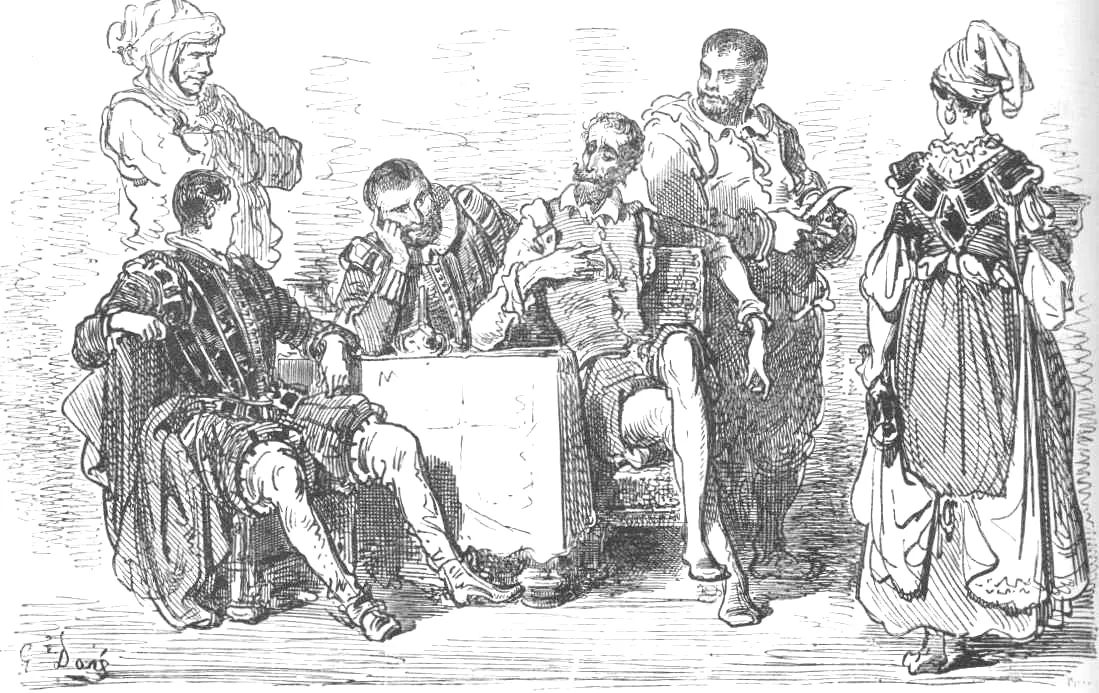
As Don Quixote was about to have supper in his room, he heard a voice from the next room, behind nothing more than a thin partition. “Don Jerónimo, while supper is coming, let’s have one more chapter of this new Don Quixote, the Part Two.”
At the sound of his name, Don Quixote sprang to his feet and pricked up his ears. A man called Don Jerónimo answered that anyone who had read the First Part could not enjoy such a botched Second Part. A man called Don Juan wanted to read on anyway. No book is so bad that it has nothing good in it, he said. What displeased him most in this one was that it showed Don Quixote no longer in love with Dulcinea.
Don Quixote was furious and raised his voice. “Whoever says Don Quixote of La Mancha has forgotten Dulcinea of El Toboso, or ever could, I shall teach with equal arms that he strays far from the truth. The peerless Dulcinea cannot be forgotten, and in Don Quixote there is no room for forgetting.”
From the other room someone asked who was answering them.
Sancho answered for him. “Who else? Don Quixote of La Mancha himself, who’ll make good everything he’s said and everything he’s going to say. A man who pays his debts doesn’t fret about the pledge.”
At once two gentlemen came into the room, and one of them threw his arms around Don Quixote’s neck. “Your face cannot belie your name, and your name cannot help vouching for your face. You, sir, are surely Don Quixote of La Mancha himself, the true one, the lodestar of knight-errantry, whatever the author of this book says, who tried to steal your name and wipe out your deeds.”
He put into Don Quixote’s hands the book his companion was holding.
Three Faults
Don Quixote leafed through it without a word, then soon handed it back. “In the little I have seen, I find three faults in this author. The first is some words I read in the preface. The second is that his language is Aragonese, so that he drops his articles.”
The third, he said, showed the man’s ignorance best of all. He strays from the truth at the most important point of the story. “Here he calls the wife of my squire Sancho Panza Mari Gutiérrez, when her name is not that but Teresa Panza. A man who errs on so important a point may well be feared to err in all the rest.”
Sancho joined in. “What a fine historian! Calling my wife Teresa Panza Mari Gutiérrez, he must know all about our doings. Master, pick up that book again and see if I’m in it, and whether he’s changed my name too.”
But this moment has one more layer to it.
Back in Part I, Chapter 7, talking about the island, Sancho himself called his wife “Juana Gutiérrez.” A few words later he called her “Mari Gutiérrez.” The last chapter of Part I also wrote her down as Juana Panza (chapter 18). Only in the Second Part does she say herself that the name she was given at baptism is Teresa (chapter 20).
The name he called the false sequel’s worst fault was written in the true First Part first, and the narrator passes over it without a word.
A Sancho Someone Else Drew
Don Jerónimo looked at Sancho. “From the way you talk, my friend, you must be Sancho Panza, Don Quixote’s squire.”
“That’s me, and I’m proud of it.”
“Well, this modern author does not treat you as cleanly as you look. He makes you a glutton and a simpleton and not the least bit funny, a different man from the Sancho in the First Part.”
Sancho did not get angry. “May God forgive him. He should have left me in my corner. Let the man who knows the instrument play it, and Saint Peter belongs in Rome.”
The two gentlemen invited Don Quixote to have supper in their room, knowing the inn had nothing worthy of him. Courteous as ever, Don Quixote accepted. Sancho took sole charge of the pot of cow heels and sat at the head of the table, and beside him sat the innkeeper, who was as fond of cow heels as Sancho.
Over supper Don Juan asked for news of Dulcinea. Had she married, had she children, or was she still a maiden who remembered Don Quixote’s devotion?
“Dulcinea remains a maiden, my devotion is firmer than ever, her replies are as dry as they always were, and her beauty has been turned into the shape of a coarse peasant girl.”
Then he told them, point by point, about Dulcinea’s enchantment and the sights down in the Cave of Montesinos. He told them, too, of Merlin’s order that Sancho must be whipped to set her free.
The two gentlemen marveled at the strange tale, and marveled again at the elegant way he told it. One moment he seemed wise, and the next he slid toward foolishness, so they could not decide where to place him.
When Sancho had finished eating, he came over to his master’s room. “I can see the man who wrote that book calls me a glutton, but I’d rather he didn’t call me a drunkard too.”
He did, Don Jerónimo said, though he could not remember how. But it was ugly to hear, and looking at good Sancho’s face, he could tell it was a lie.
Sancho said this. “Believe me, the Sancho and Don Quixote in that story must be different people from the ones in the story Cide Hamete Benengeli wrote. That’s where we are. My master is brave and wise and faithful in love, and I’m comically simple, but no glutton and no drunkard.”
Don Juan said he believed it too. If it were possible, no one but Cide Hamete, the first author, should be allowed to handle the deeds of the great Don Quixote. It would be like Alexander the Great, who allowed no one but Apelles to paint his portrait.
Don Quixote saw it a little differently. “Let anyone paint me who wishes, so long as he does not abuse me. Patience gives way when it is loaded with insult after insult.”
They talked late into the night. Don Juan hoped he would read more of the book. But he said he would count it as read and judge it foolish from cover to cover. If the author ever heard the book had been in his hands, he might rejoice to think he had read it, and that was reason enough. From filthy and foolish things, he said, one should keep not only one’s eyes but even one’s thoughts far away.
Not Zaragoza
Asked where he was headed, Don Quixote said Zaragoza. He meant to take part in the tournament in armor held there every year.
Don Juan said that new story had Don Quixote, whoever he was, riding at the ring in Zaragoza. It was short on invention, poor in its writing and poorer in its costumes, he said, and rich only in nonsense.
Don Quixote replied.
“…no pondré los pies en Zaragoza, y así sacaré a la plaza del mundo la mentira dese historiador moderno, y echarán de ver las gentes como yo no soy el don Quijote que él dice.” …then I shall not so much as set foot in Zaragoza. That way I will drag the lie of this modern historian into the public square of the world, and everyone will find out that the Don Quixote he writes of is not me. (Part II, Chapter 59)
Don Jerónimo said that was well thought of. There were tournaments in Barcelona too, where he could show his valor. Don Quixote said he would do just that. It was time for bed now, he said, and he asked them to count him among their closest friends and servants.
Sancho added his piece. “Me too. Maybe I’ll be good for something.”
The two gentlemen stayed in their room marveling at how he had mixed his wisdom and his madness together. And they truly believed that these two were the real Don Quixote and Sancho, not the ones drawn by the Aragonese author.
The next morning Don Quixote rose early and knocked on the partition to say goodbye to the guests next door. Sancho paid the innkeeper generously, and advised him next time either to boast less about his bill of fare or to keep his kitchen better stocked.
The Steps That Beat a Lie
In chapter 19 he met readers of his own story for the first time. In this chapter what he meets is someone else’s story with his name on it. On the same day he was treated twice as a character from a book. The shepherdess in the wood said he was the bravest of knights, unless the book she had read was lying. The gentlemen at the inn believed he was the real one from his face and the way he talked.
Don Quixote does not set out with his sword after the false author. He changes his road instead.
If he does not go where that book says, he reasons, everyone who read it will learn which one is false. Yet going to Barcelona for that reason means, when you think about it, that the book chose his road for him once.
Sancho’s answer was shorter. The Sancho in that book is not him, and the real Sancho is inside the story Cide Hamete wrote. Yet Cide Hamete is himself the chronicler who wrote in the margin of the cave story that it was hard to believe as true (chapter 26). The two of them do not leave it to any book to decide which one is real. They leave it to themselves, out on the road.
Have you ever met someone who got the wrong idea about you because of someone with your name or your looks?