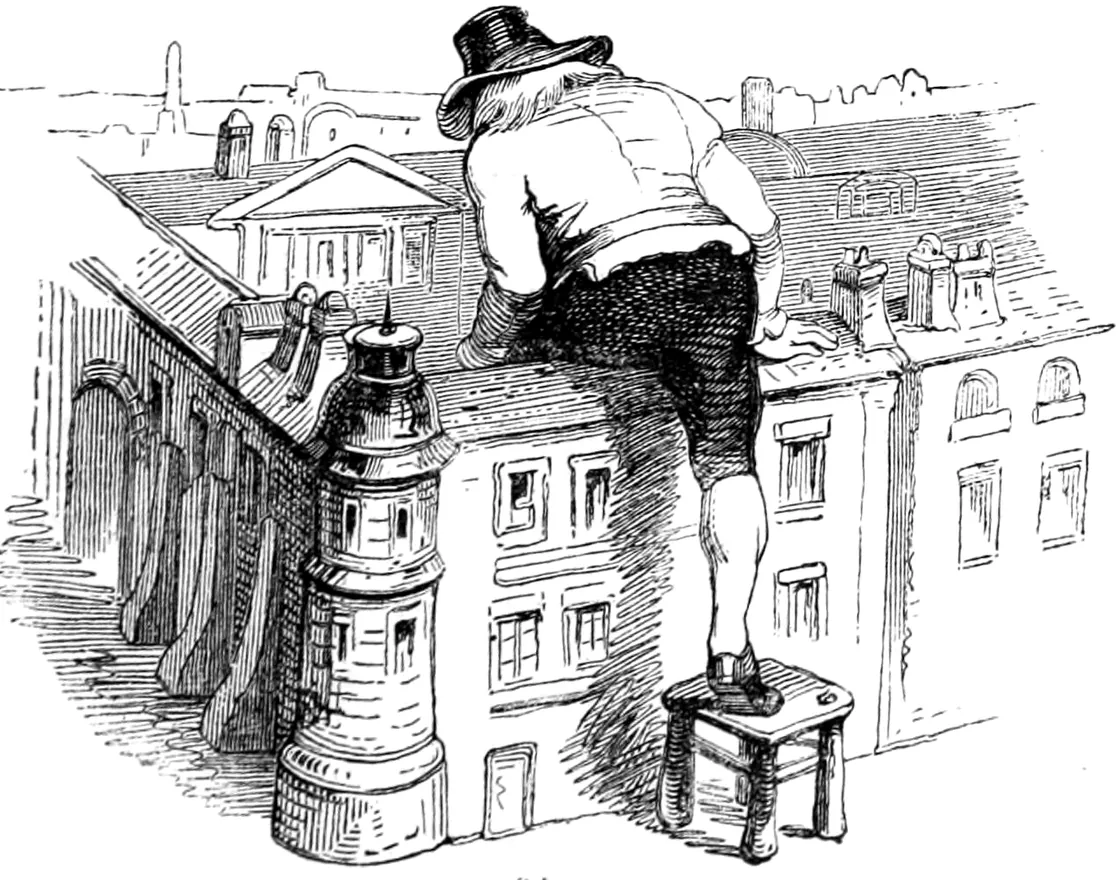
The first thing Gulliver asks for, once he has his liberty, is leave to see Mildendo, the capital. The emperor grants it easily, with a special charge to harm neither the people nor their houses. A proclamation goes out in advance. Everyone is to stay indoors.
The wall round the town is two and a half feet high and nearly a foot thick, so a coach and horses can be driven along the top. Strong towers stand every ten feet.
Gulliver steps over the great western gate and passes very slowly, sidling, through the two main streets. He wears only his short waistcoat, for fear the skirts of his coat will catch the roofs and eaves. Anyone found outside is there at their own peril, but he still watches every step in case some straggler is left in the road.
Every garret window and rooftop is so packed with onlookers that he thinks he has never seen a more crowded place in all his travels.
A city of half a million
The town is an exact square, each side of the wall five hundred feet long. The two great streets cross in the middle and cut it into four quarters, and each is five feet wide.
The lanes are twelve to eighteen inches across, so Gulliver cannot go in, only look as he passes. The houses rise three to five stories, and the shops and markets are well stocked. Five hundred thousand people live here.
The emperor’s palace stands at the centre, where the two great streets meet. The buildings of the outer court are over five feet high and would be badly damaged if he tried to stride over them. The gates leading inward are only eighteen inches high and seven inches wide.
The emperor very much wants Gulliver to see the splendour of his palace. So Gulliver spends three days cutting down some of the largest trees in the royal park with his knife. From them he makes two stools about three feet high, strong enough to bear his weight.
He stands on one stool and lifts the other over the roof, setting it down gently in the open space beyond. He steps across from stool to stool, then draws the first one up after him with a hooked stick.
That way he reaches the innermost court. Lying on his side, he puts his face to the windows that have been left open for him, and sees the most splendid rooms imaginable. The empress smiles at him and gives him her hand to kiss through the window.
He will save the rest of the description, he says, for a larger book he is writing. It covers the empire’s history, laws, learning, plants and animals, and is almost ready for the press.
A friend comes calling
One morning, about two weeks after his release, Reldresal, the principal secretary for private affairs, comes to Gulliver’s house with a single servant. He leaves his coach waiting at a distance and asks for an hour’s talk.
Gulliver offers to lie down so his ear will be easier to reach. Reldresal prefers to be held in Gulliver’s hand while they speak.
He begins by congratulating Gulliver on his liberty, and says he may claim some small credit for it. Then he adds that without the present state of things at court, Gulliver might not have been freed so soon.
However flourishing the empire may look to foreigners, he says, it labours under two great evils. One is a violent faction at home. The other is a powerful enemy abroad.
The height of a heel
For about seventy moons, two parties have been struggling in the empire. They are the high heels and the low heels. It is said that high heels suit the ancient constitution better. But the emperor has decided to use only low heels in governing, and in every office he gives.
His own heels are lower than anyone’s at court by at least a drurr, which is about a fourteenth of an inch.
The hatred between the parties runs so deep that they will neither eat nor drink nor talk with each other. The high heels are more numerous, Reldresal says, but all the power is on the side of the low.
There is one worry, though. The heir to the throne seems to lean toward the high heels. At least it is plain that one of his heels is higher than the other, which gives him a hobble when he walks.
Dropped from the moon
In the middle of this unrest at home, the island of Blefuscu threatens to invade. Blefuscu is the other great empire of the world, almost as large and strong as Lilliput.
Here Reldresal pauses on something Gulliver has said. There are, Gulliver claims, other countries in the world where people as big as he is live. The philosophers here very much doubt it.
They would rather guess that he dropped from the moon or one of the stars. A hundred people his size would soon eat up all the fruit and cattle in the emperor’s lands.
Besides, their histories cover six thousand moons and mention no other lands than the two great empires of Lilliput and Blefuscu.
It started with a finger
For thirty-six moons the two empires have been locked in a most stubborn war. This, says Reldresal, is how it began. Everyone agrees that the original way to break an egg before eating it was at the larger end. But when the present emperor’s grandfather was a boy, he broke an egg in the old way and cut his finger.
His father, the emperor at the time, issued an edict. All subjects were to break their eggs at the smaller end, on pain of heavy penalties.
The people resented the law so bitterly that, the histories say, six rebellions broke out over it. One emperor lost his life and another his crown.
The kings of Blefuscu always stirred these rebellions up. When one was put down, the exiles always fled to Blefuscu for refuge. It is reckoned that eleven thousand people, at one time or another, chose death rather than break their eggs at the smaller end.
Many hundreds of thick volumes have been published on the controversy. But the books of the Big-endians have long been banned, and the whole party is barred by law from holding any office.
The convenient end
All through these troubles, the emperors of Blefuscu sent ambassadors to rebuke Lilliput. Lilliput, they said, had split the faith by breaking a fundamental teaching of the great prophet Lustrog. That teaching is in the fifty-fourth chapter of the scripture called the Blundecral.
Reldresal thinks this merely strains the text. These are the words in that chapter.
“that all true believers break their eggs at the convenient end.” (Part I, Chapter 4)
Which end is convenient, he says carefully, seems to be left to each person’s conscience. Or at least it is in the power of the chief magistrate to decide.
Thirty-six moons of war
The Big-endian exiles have won great credit at the court of Blefuscu. Their party back home in Lilliput gives them secret help, and urges them on.
So for thirty-six moons a bloody war has gone on, with victories and losses on both sides. Lilliput has lost forty great warships and many more small vessels. Thirty thousand of its best seamen and soldiers are gone.
The enemy’s losses are reckoned to be somewhat greater. And now that enemy has fitted out a large fleet and is about to invade. The emperor, he says, has great faith in Gulliver’s courage and strength, and has ordered him to lay all this before Gulliver.
A foreigner’s answer
Gulliver asks Reldresal to give the emperor his humble duty, and this message.
He does not think it would become him, a foreigner, to interfere with parties. But he is ready, at the risk of his life, to defend the emperor’s person and state against all invaders.
Today, what is the egg
In this chapter people stake their lives on two things, the height of a shoe heel and the end of an egg.
In the heel quarrel, the emperor’s heels are lower by a fourteenth of an inch, and the heir hobbles because his two heels differ. In the egg quarrel, a cut finger became an edict. The edict became six rebellions, eleven thousand deaths and thirty-six moons of war.
The scripture that all of it rests on says only to break eggs at the convenient end.
Reldresal tells the whole story without saying which side is right. Gulliver does not ask. He answers that he will not meddle, and in the same breath promises to defend the realm.
Of the quarrels I have thrown my whole heart into, if not my life, which one turned out, looking back, to be about which end of the egg?