Being shown every day changes Gulliver’s health a great deal within a few weeks. The more his master makes from him, the greedier his master grows.
Gulliver loses his appetite completely and is reduced almost to a skeleton. The farmer sees it and decides he will soon die. In that case, he means to make as much from him as he can first.
While he is working this out, a sardral, a gentleman-usher, arrives from court. The order is to bring Gulliver to the palace at once for the amusement of the queen and her ladies. Some of the ladies have already seen him and reported wonders of his looks, manners and good sense.
A thousand pieces of gold
The queen and those around her are delighted beyond measure with his behaviour. He kneels and begs the honour of kissing her foot. She holds out her little finger to him on the table, and he embraces it in both arms and touches its tip to his lips with the utmost respect.
The queen asks him a few questions about his country and his travels. Then she asks whether he would be content to live at court.
Gulliver bows down to the table and answers that he is his master’s slave, but that if he were free to choose, he would be proud to spend his life in her service.
The queen asks the farmer whether he will sell him at a good price. Expecting Gulliver not to live a month, the farmer readily asks a thousand pieces of gold, and the queen has it paid on the spot.
Gulliver asks the queen one favour. Now that he is her subject, he says, may Glumdalclitch, who has always cared for him so well, be taken into her service, and stay on as his nurse and teacher?
The queen agrees, and the farmer, glad to see his daughter placed at court, easily consents. The poor girl cannot hide her joy.
A cold bow
As he leaves, the farmer tells Gulliver he has left him in a good place. Gulliver says not a word and only gives him a slight bow.
The queen notices the coldness and asks why. Gulliver boldly tells her this.
All he owed his former master was that the man did not dash out the brains of a harmless creature found by chance in his field. That debt has been amply repaid by what he earned showing Gulliver through half the kingdom, and by the price he has just been paid.
The life since then has been hard enough to kill an animal ten times his strength. If his master had not thought his life in danger, Her Majesty would never have got so cheap a bargain.
He adds praise in the style of that country. The queen is the ornament of nature, the darling of the world and the phoenix of creation, and already in her presence his spirits revive. He learned the phrases from Glumdalclitch on the way to court.
A piece of clockwork
The queen is astonished at so much wit and sense in so small an animal. She takes him in her hand and carries him to the king.
The king, a grave and stern-faced prince, does not see him clearly lying on his face in the queen’s hand. He asks coldly how long she has been fond of a splacnuck.
The queen, who has great wit, sets him gently on his feet on the king’s desk and tells him to give an account of himself. Gulliver does so in a few words. Glumdalclitch has been waiting outside the door, unable to bear him out of her sight. She is let in and confirms everything since he came to her father’s house.
The king is as learned as anyone in his kingdom and has studied philosophy and mathematics. Even so, seeing Gulliver walk upright, before he speaks, he takes him for a piece of clockwork made by some clever artist. Clockwork is highly advanced in that country.
But when he hears Gulliver’s voice and finds what he says orderly and rational, he cannot hide his astonishment.
Suspected of a set speech
Still the king does not believe his account of how he came into the kingdom. He thinks Glumdalclitch and her father have cooked it up, teaching him a set of words to make him sell for more.
So the king asks him other questions. Each time, Gulliver gives a rational answer. His only faults are a foreign accent, an imperfect grasp of the language, and a few country phrases from the farmhouse that do not suit the polished speech of a court.
Three scholars
The king sends for three great scholars who happen to be on their weekly duty at court.
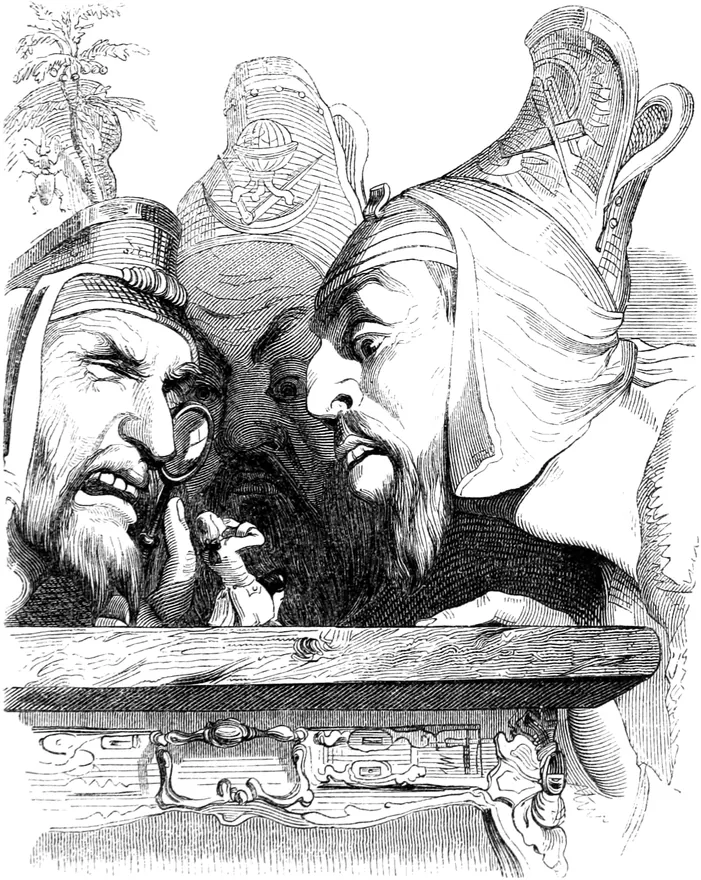
After examining Gulliver’s shape very closely for a while, they differ in their opinions. But on one point they all agree. He cannot have been produced by the regular laws of nature.
He cannot run fast, climb trees or dig holes, so he has no way of preserving his life. His teeth show he eats flesh, yet most four-footed beasts are stronger than he is, and field mice and the like are too quick for him. Unless he lives on snails and insects, he cannot survive, and they offer many learned arguments to prove he cannot do that either.
One of them suggests he might be an embryo, an unfinished birth. The other two reject this. His limbs are perfect and finished, and the stubble of his beard, plain under a magnifying glass, shows he has lived several years.
Nor can they call him a dwarf. He is too small to compare with anything. Even the queen’s dwarf, the smallest ever known in the kingdom, is nearly thirty feet tall.
A freak of nature
After much debate they conclude unanimously that Gulliver is only relplum scalcath. Translated literally, that is a freak of nature.
Gulliver writes that this verdict agrees exactly with the modern philosophy of Europe. Its professors scorn the old excuse of occult causes, by which Aristotle’s followers tried in vain to hide their ignorance. Instead they have invented this wonderful solution to every difficulty. Thanks to it, he sneers, human knowledge has advanced beyond words.
After the verdict, Gulliver asks to say a word or two. He tells the king that he comes from a country with several million men and women of his own size. There, the animals, trees and houses are all in proportion. So he can defend himself and find food there just as the king’s subjects can here.
He takes this to be a full answer to the scholars’ arguments. They only smile contemptuously and say the farmer has taught him his lesson very well.
The king’s judgement
The king, who has far better sense than his scholars, sends them away and calls for the farmer, who by luck has not yet left town. He questions him privately first, then brings him face to face with Gulliver and the girl. Only then does the king begin to think their story may be true.
He asks the queen to have particular care taken of Gulliver. Seeing how fond the two are of each other, he says Glumdalclitch should go on looking after him.
She is given a comfortable room at court. A governess is appointed for her education, a maid to dress her, and two servants for menial work. But the care of Gulliver remains hers alone.
The queen’s cabinet-maker builds him a wooden room in three weeks, to the design Gulliver and Glumdalclitch agree on. It is sixteen feet square and twelve feet high. It has sash windows, a door and two closets, like a London bedchamber. The ceiling lifts on two hinges, so Glumdalclitch can take out the bed every day to air it, and lock the roof over him at night.
The room is quilted on every side, floor and ceiling too, so that careless bearers or a jolting coach will not hurt him. He asks for a lock on his door to keep out rats and mice.
The queen’s table
The queen grows so fond of his company that she cannot dine without him. His little table and chair are placed on her table, right by her left elbow. Glumdalclitch stands on a stool on the floor to help him.
His silver dishes and plates are no bigger than the furniture of a doll’s house in a London toy shop. His little nurse keeps them in a silver box in her pocket, hands them to him at meals, and cleans them herself.
The queen loves watching him eat in miniature. For some time, Gulliver finds watching her eat a sickening sight. The queen, said to have a weak stomach, takes in one mouthful as much as a dozen English farmers eat at a meal. She crunches a lark’s wing, bones and all, nine times the size of a full-grown turkey’s.
Whig or Tory
Every Wednesday the king and queen dine with their children in the king’s rooms. By then Gulliver is a great favourite with the king, and his little chair and table are set at the king’s left hand, in front of a salt-cellar.
The king enjoys talking with him and asks about the manners, religion, laws, government and learning of Europe. Gulliver explains as well as he can. The king’s mind is so clear and his judgement so exact that he makes wise remarks on everything Gulliver says.
But one day Gulliver talks a little too long about his beloved country. He covers trade and wars by sea and land, religious schisms and the parties of the state.
The king bursts out laughing. Taking him in his right hand and stroking him gently with the other, he asks whether he is a Whig or a Tory.
Then he turns to his first minister, who stands behind him with a white staff nearly as tall as the mainmast of a royal warship, and speaks.
“how contemptible a thing was human grandeur, which could be mimicked by such diminutive insects as I” (Part II, Chapter 3)
And the king goes on. He will wager these little creatures have titles and honours too. They build little nests and burrows and call them houses and cities. They show off in clothes and carriages. They love, they fight, they dispute, they cheat, they betray.
Two figures in the mirror
As the king goes on, Gulliver’s colour comes and goes with indignation. His noble country, mistress of arts and arms, scourge of France and arbiter of Europe, is being treated with contempt. It is the seat of virtue, piety, honour and truth, the pride and envy of the world.
But he is in no position to resent it. And on reflection he begins to doubt whether he has been insulted at all.
For months he has lived among these people, and everything his eyes fall on is in proportion to them. His first horror at their size has mostly worn off. What if he now saw a company of English lords and ladies in their birthday finery, strutting, bowing and chattering? He would be tempted to laugh at them just as the king and his court laughed at him.
When the queen holds him up on her hand before a mirror, he cannot help laughing at himself. Side by side in one glass, nothing could be more ridiculous than the comparison. He really begins to feel he has shrunk many times below his normal size.
A dwarf who meets someone smaller
Nothing angers and humiliates Gulliver so much as the queen’s dwarf.
He is the smallest person ever known in that country. He cannot be a full thirty feet tall. Yet at the sight of someone so much smaller than himself, he grows very insolent.
When Gulliver stands on a table in the queen’s antechamber talking with lords and ladies, the dwarf always swaggers past. He seldom fails to throw in a sharp word about Gulliver’s littleness. All Gulliver can do in return is call him brother and challenge him to wrestle.
One day at dinner, stung by something Gulliver has said, the dwarf climbs up on the frame of the queen’s chair. He catches Gulliver round the middle as he is sitting down, drops him into a large silver bowl of cream and runs away.
Gulliver goes in over his head. If he had not been a good swimmer, it could have gone very badly. Glumdalclitch happens to be at the other end of the room, and the queen is too frightened to help. By the time his little nurse runs over and pulls him out, he has swallowed more than a quart of cream.
The dwarf is soundly whipped and, as further punishment, made to drink the whole bowl. He never wins back favour. The queen soon gives him away to a lady of rank, and Gulliver never sees him again.
Once before, the dwarf had squeezed Gulliver’s legs together and wedged him up to the waist in a hollowed marrow-bone. Thinking it beneath him to cry out, Gulliver stuck there for some time in a ridiculous pose. That time, at Gulliver’s plea, the dwarf got only a whipping.
In summer the country swarms with flies as big as Dunstable larks. The dwarf would catch handfuls, as schoolboys do, and let them loose under Gulliver’s nose to scare him and amuse the queen. Gulliver would slice them in the air with his knife, and his skill was much admired.
The queen often teases him about how easily frightened he is. She asks whether the people of his country are all such cowards as he.
Today, a name for what we do not know
In this chapter Gulliver is judged many times over. The king calls him a splacnuck, then clockwork, then an animal the farmer has taught to talk. The three scholars call him a freak of nature.
Every one of these verdicts comes out of what the judges already know. To the scholars, the claim that a whole nation of people his size exists beyond their kingdom is just a lesson well recited.
The king laughs and says human grandeur is contemptible, and Gulliver, after his anger, says he can understand the laugh. And the smallest man in the kingdom grows most insolent of all on meeting someone smaller than himself.
When someone smaller or younger than me came along, how did I treat them?