Gulliver had lived five years in the land of the Houyhnhnms, a country ruled by horses, before he was banished. In that country the hairy beasts that looked like people were called Yahoos, and now he sees every human being as a Yahoo. The ship of Pedro de Mendez, the Portuguese captain who picked him up at sea, reached Lisbon on November 5, 1715.
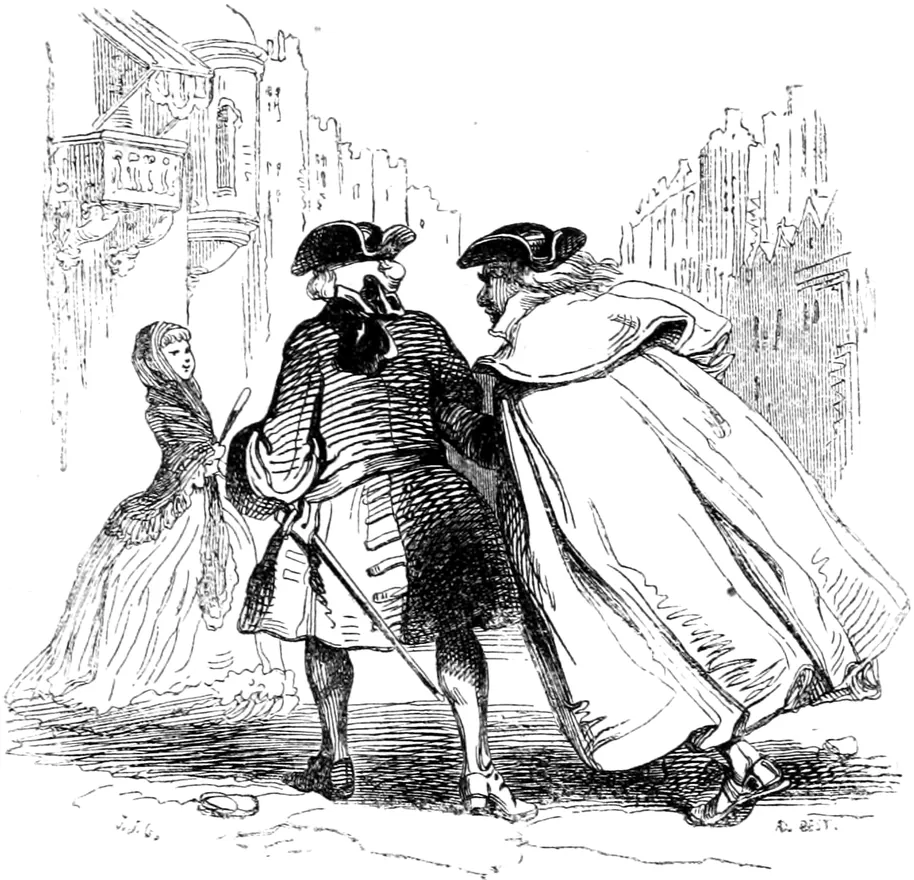
As they landed, the captain threw his own cloak over Gulliver so that no crowd would gather. Then he took him to his own house. At Gulliver’s earnest request, the captain led him up to the highest room at the back.
Gulliver begged the captain to tell no one what he had heard about the Houyhnhnms. The least hint of such a story would bring people crowding to see him. He might even be imprisoned or burned by the Inquisition.
Measurements not taken
The captain persuaded him to accept a newly made suit of clothes. But Gulliver would not let the tailor take his measurements. Luckily the captain was almost his size, so the clothes fitted well enough.
The captain also supplied him with everything else he needed, all new, and Gulliver aired it all for twenty-four hours before he would use it.
From the window to the door
The captain had no wife and only three servants, and he would not let them wait at meals. His manner was always obliging and his good sense was excellent. Gulliver really began to tolerate his company.
Thanks to the captain, Gulliver made progress little by little. First he looked out of the back window. Then he was moved to another room, peeped into the street and drew his head back in fright.
After a week the captain coaxed him down to the door. His terror slowly lessened, but his hatred and contempt seemed to grow. At last he was bold enough to walk the streets with the captain. Even so, he kept his nose well stopped with rue or tobacco.
A matter of honour and conscience
On the tenth day the captain raised the subject. Gulliver had told him a little about his family. It was a matter of honour and conscience, the captain said, to go home and live with his wife and children.
There was an English ship in port about to sail, he said, and he would provide everything needed. Gulliver writes that it would be tedious to repeat the captain’s arguments and his own objections.
The captain said the lonely island Gulliver longed for could not be found anywhere in the world. But in his own house he would be master, and could live as much alone as he liked.
Finding nothing better to do, Gulliver gave in at last. On November 24 he left Lisbon on an English merchant ship. He never asked who its master was.
Captain Pedro saw him to the ship and lent him twenty pounds. Then he took a kind leave and embraced him. Gulliver bore that embrace as well as he could.
A voyage without a word
On this last voyage Gulliver had no dealings with the ship’s master or any of the crew. Pretending to be ill, he kept to his cabin the whole way.
At about nine in the morning on December 5 the ship cast anchor in the Downs. At three that afternoon he reached his house in Rotherhithe safely.
The man they thought was dead
His wife and family received him with great surprise and joy. They had been sure he was dead.
But Gulliver confesses it frankly. The sight of them filled him only with hatred, disgust and contempt. It was worse when he thought how closely he was tied to them.
Since his banishment from the Houyhnhnms he had forced himself to tolerate the sight of Yahoos. He had even talked with Don Pedro de Mendez. Yet his memory and imagination were always full of the virtues and ideas of those noble Houyhnhnms.
Then it came to him that he too was a father of Yahoos and had added to their number. He was seized with the utmost shame, confusion and horror.
An hour
As soon as he stepped into the house, his wife took him in her arms and kissed him.
“at which, having not been used to the touch of that odious animal for so many years, I fell into a swoon for almost an hour.” (Part IV, Chapter 11)
Five years on
As Gulliver writes this, five years have passed since he last came back to England.
For the first year he could not bear his wife or children in his presence. Their very smell was unbearable, and he could still less let them eat in the same room.
To this day they dare not touch his bread or drink from the same cup. He has never yet been able to let any one of them take him by the hand.
Two horses in the stable
The first money he spent went on two young horses, which he keeps in a good stable. After them, the person he likes best is the groom. The smell the groom brings back from the stable revives his spirits.
The horses understand him fairly well. He talks with them for at least four hours every day.
They have never known bridle or saddle. They live in great friendship with Gulliver and with each other.
Today, a home grown strange
In this chapter Gulliver comes home after five years. His family, who thought him dead, were surprised and overjoyed, but when his wife embraced him he fainted for nearly an hour.
In the five years since, he has not let his family take his hand, and he talks every day for four hours with two horses in the stable. Gulliver sets all of this down calmly, hiding nothing.
When I came back after a long time away, did something familiar ever feel strange? When did that strangeness pass, and what eased it?