Gulliver was given leave to visit the grand academy of Lagado. It is not one building but a row of houses on both sides of a street. When the street fell into ruin, the houses were bought up and turned into the academy.
The warden received him very kindly, and he went there for many days. Every room held at least one projector, and Gulliver must have seen more than five hundred rooms.
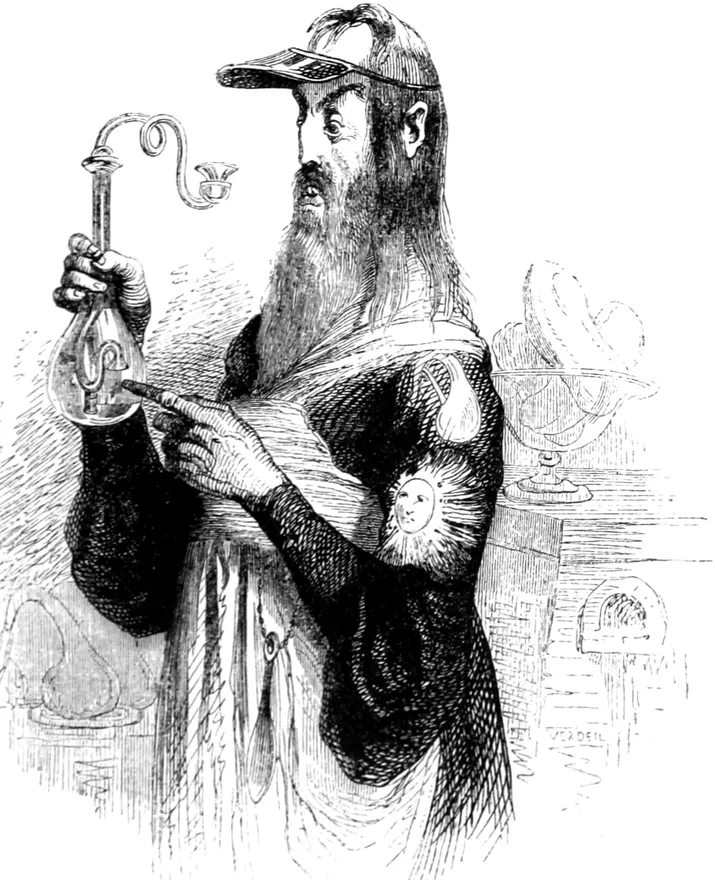
Sunshine in a cucumber
The first man he saw was thin, with sooty hands and face. His hair and beard were long, ragged and singed in places. His clothes, shirt and skin were all the same colour.
For eight years he had been working on a scheme to extract sunbeams from cucumbers. The sunbeams would be sealed in jars and let out to warm the air in cold, raw summers.
He had no doubt that in eight more years he could supply the governor’s gardens with sunshine at a reasonable rate. But he complained that his funds were low and begged Gulliver for something to encourage ingenuity. Cucumbers had been very dear this season, he said.
Gulliver gave him a small present. Munodi had given him money for the purpose, knowing the projectors begged from everyone who came to see them.
A house built from the roof
Another man was trying to turn ice into gunpowder by burning it. He also showed Gulliver a treatise he had written on the malleability of fire, which he meant to publish.
A most ingenious architect had devised a new way of building houses. He began at the roof and worked downward to the foundation. He defended his method by the example of two prudent insects, the bee and the spider.
A man born blind had several apprentices in the same condition. Their work was mixing colours for painters, and their master taught them to tell the colours apart by feeling and smelling.
Unluckily, when Gulliver visited, the apprentices had not yet learned their lessons well, and the master himself was generally wrong. Still, this artist was much encouraged and admired by the whole fraternity.
Hog ploughs and spider silk
In another room Gulliver was very pleased with a projector who had found a way to plough with hogs. It saved the cost of ploughs, cattle and labour.
The method is this. In an acre of ground you bury acorns, dates, chestnuts and other food hogs love, six inches apart and eight deep. Then you drive six hundred or more hogs into the field, and within a few days they root up the whole ground looking for food and make it fit for sowing.
When tried, it proved very costly and troublesome, and there was little or no crop. Yet no one doubts, Gulliver notes, that the invention is capable of great improvement.
In another room the walls and ceiling were covered in cobwebs, except a narrow path for the projector to get in and out. As Gulliver entered, the man shouted at him not to disturb his webs.
He lamented the world’s long, fatal mistake of using silkworms. Ordinary household spiders were far better, he said, because they could weave as well as spin.
Using spiders would save the cost of dyeing silk too, he said. He showed Gulliver a great many beautifully coloured flies. Fed on these, the spiders would spin webs of the same colours. Gulliver writes that he was fully convinced.
An astronomer meant to put a sundial on the great weathercock of the town hall. He would adjust the yearly and daily motions of earth and sun so that the dial would agree with every chance turn of the wind.
The universal artist
Gulliver visited many other rooms, but in the interest of brevity he will not list all the curiosities. One man, though, he must mention. The projectors call him the universal artist.
He said he had spent thirty years thinking about how to improve human life. He had two large rooms full of wonders and fifty men at work.
Some were condensing air into a dry, solid substance. Some were softening marble for pillows and pincushions. Others were turning the hoofs of a living horse to stone to keep them from harm.
The artist himself was busy with two great designs. One was to sow land with chaff, in which he said the true power of the seed lay. The other was to rub a mixture on two young lambs so that no wool would grow. In time he hoped to spread a breed of naked sheep throughout the kingdom.
A machine that writes books
The other side of the academy belonged to the projectors in speculative learning. The first professor Gulliver met was in a very large room with forty pupils around him.
Seeing Gulliver staring at a great frame that took up most of the room, the professor spoke. Gulliver might be surprised, he said, to see him improving speculative knowledge by practical, mechanical means. But the world would soon see how useful it was, and no nobler thought had ever entered any man’s head.
“the most ignorant person, at a reasonable charge, and with a little bodily labour, might write books in philosophy, poetry, politics, laws, mathematics, and theology, without the least assistance from genius or study.” (Part III, Chapter 5)
The frame was twenty feet square and stood in the middle of the room. Its surface was covered with bits of wood about the size of dice, joined together by slender wires. Paper was pasted on every bit, and on the papers were written all the words of their language in all their forms, in no order at all.
At the professor’s command, each pupil took hold of one of forty iron handles round the edge of the frame and gave it a sudden turn. The arrangement of the words changed completely.
Thirty-six of the pupils read the lines that appeared on the frame quietly. Wherever they found three or four words together that might make part of a sentence, they read them out to the other four, who wrote them down. This was repeated three or four times.
The pupils worked at this six hours a day. The professor showed Gulliver several large volumes of the broken sentences already gathered. He meant to piece them together and give the world a complete body of all the arts and sciences.
It would go much faster, he said, if the public raised a fund to build five hundred such frames in Lagado. It would be better still if their managers had to pool what they collected. He had given this invention all his thoughts since his youth, and had even calculated exactly the proportions of the parts of speech in books.
Gulliver thanked him most humbly. He promised that if he ever got home, he would make the professor known as the sole inventor of this wonderful machine.
European scholars, Gulliver added, are in the habit of stealing inventions from one another, so it often becomes a dispute who the true owner is. Even so, he would take care that the honour was the professor’s alone, without a rival.
Things instead of words
Next they went to the school of languages, where three professors were discussing how to improve their own tongue.
The first scheme was to shorten speech. Words of many syllables would be cut to one, and verbs and participles left out. In reality, everything imaginable is only a noun.
The second scheme was to abolish all words entirely. It would be healthier as well as shorter. Every word we speak wears away the lungs a little and so shortens our lives.
Since words are only names for things, they said, it would be more convenient to carry about the things one needs for a conversation. This invention would surely have been adopted. But the women, joined by the common and unlettered people, threatened rebellion unless they were allowed to speak with their tongues like their ancestors. Such constant enemies of science are the common people, Gulliver writes.
Still, many of the most learned and wise follow the new way of speaking in things. It has only one drawback. A man with great and varied business must carry a bigger bundle on his back, unless he can afford a strong servant or two.
Gulliver often saw two such sages almost sinking under their packs like pedlars. When they met in the street, they would set down their loads, open their sacks and talk for an hour. Then they put their things away, helped each other shoulder their burdens and parted.
The invention had another great advantage. The goods and utensils of civilised nations are mostly alike, so it would serve as a universal language. Ambassadors could then treat with foreign princes or ministers whose language they did not know at all.
Swallowed mathematics
The master of the mathematical school taught by a method hardly imaginable in Europe. The proposition and proof were written on a thin wafer, in ink made from a medicine good for the head. The pupil swallowed it on an empty stomach and for three days ate nothing but bread and water.
As the wafer digested, the medicine was supposed to carry the proposition up to the brain. But so far it has not worked as hoped. Partly the dose or mixture has been wrong, and partly the boys are stubborn. They find the wafer so nauseating that they usually slip away and bring it back up, and they cannot be persuaded to fast as long as the prescription requires.
Today, the absurd and the useless
In this chapter Gulliver walks through five hundred rooms and records the projectors’ work one by one.
There were sunshine from cucumbers, houses built from the roof, hog ploughs, spider silk and naked sheep. There were a machine that writes books and conversations held with sacks of things. Gulliver wrote that he was fully convinced by the spider silk, and promised the professor of the book machine that he would be known as its sole inventor.
Is research on our side that looks like extracting sunbeams from cucumbers merely odd, or truly useless?