Lemuel Gulliver was born the third of five sons to a family with a small estate in Nottinghamshire. He studied at Cambridge for three years until the cost became too much, and then he was apprenticed to a surgeon in London. Whatever money his father sent, he spent on navigation and mathematics.
He always believed that one day his fortune would take him far out to sea.
It did. He became a ship’s surgeon and sailed for years to the East and West Indies. In his spare hours he read good books, and ashore he studied the customs and the languages of the people. In May 1699 he left Bristol for the South Sea aboard the Antelope.
Grass after the storm
North-west of Van Diemen’s Land the ship runs into a violent storm. Twelve of the crew have already died of overwork and bad food, and the rest are in poor shape.
On a hazy fifth of November the sailors spy a rock too late to avoid it. The ship strikes and splits, and six men, Gulliver among them, lower the boat and row clear. Then a sudden squall from the north overturns the boat as well.
He never learned what became of the others.
He swims as the wind and tide push him. Each time he lets his legs drop there is no bottom, until, at the very end of his strength, his feet touch ground. The shore shelves so gently that he wades nearly a mile before he reaches it.
There are no houses and no people in sight. He lies down on grass that is short and soft, and sleeps more soundly than he can ever remember, for about nine hours.
Nothing but sky
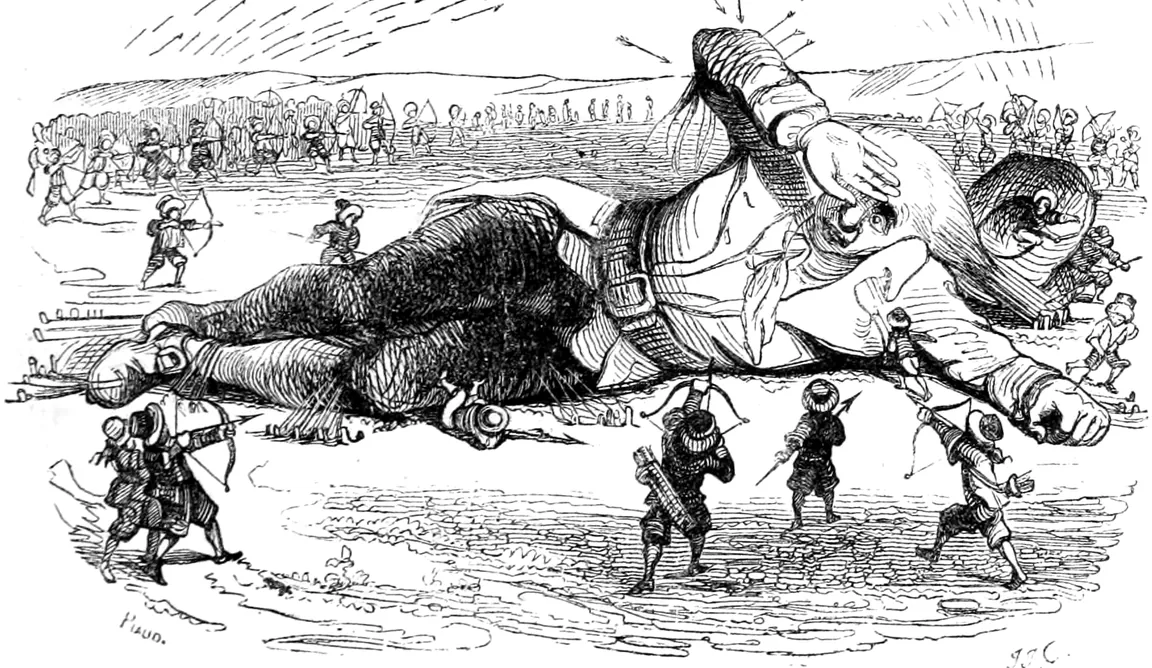
When he tries to rise he cannot move. He is lying on his back, and his arms and legs are fastened firmly to the ground on either side. His long, thick hair is tied down in the same way, and slender cords cross his body from his armpits to his thighs.
All he can see is the sky. The sun grows hot and hurts his eyes, and around him he hears a confused noise.
Something alive moves onto his left leg, walks up over his chest and stops almost at his chin. Straining his eyes downward, he sees what it is.
“I perceived it to be a human creature not six inches high, with a bow and arrow in his hands, and a quiver at his back.” (Part I, Chapter 1)
At least forty more climb up after it. Gulliver roars in astonishment, and they all run back in a fright. Some are hurt leaping from his sides to the ground.
Arrows and meat
They soon return. One of them comes close enough to see his face clearly, lifts up his hands and eyes, and cries in a shrill voice. Hekinah degul. The others repeat it again and again.
Struggling, Gulliver has the luck to break the strings and pull out the pegs that hold his left arm. The cords on his hair loosen a little too, enough to let him turn his head about two inches.
At once someone cries Tolgo phonac, and over a hundred arrows strike his left hand like needles. They shoot another volley into the air so that it falls on his body and face. A few try to stick spears into his sides, but his thick leather jerkin turns them.
He decides the wisest thing is to lie still. When night comes, his free left hand will let him loose easily enough. And if they are all the size of the first one he saw, he reckons he can deal with the largest army they could bring.
When he is quiet, the arrows stop.
For more than an hour there is knocking near his right ear, and a stage a foot and a half high goes up. A person of quality climbs it and makes a long speech. Gulliver hears threats and promises and pity in turn, and understands not one syllable.
He lifts his left hand and both eyes to the sun, as if calling it to witness, and answers humbly in a few words. Having eaten nothing for hours before he left the ship, he keeps putting his finger to his mouth. The fear of seeming rude loses to his hunger.
The hurgo, a great lord, understands at once. Ladders go up against Gulliver’s sides, and more than a hundred people climb to his mouth carrying baskets of meat.
There are legs and shoulders shaped like mutton but smaller than a lark’s wing, and he eats them two or three at a mouthful. The loaves are the size of musket balls, and he takes three at a time. Their largest barrel holds less than half a pint, so he drains it in one draught. When he empties a second, the crowd dances on his chest and shouts Hekinah degul again.
What one hand could have done
While they walk back and forth over him, Gulliver confesses, he is tempted more than once. He wants to seize forty or fifty of them as they come within reach and dash them to the ground.
He does not. What he has already felt may not be the worst they can do. He counts his humble gestures as a promise he has made. And after people have spent so much to treat him so well, he feels bound by the duties of a guest.
Even so, he cannot stop marvelling at the courage of these tiny people, who walk across the body of a giant with one hand free and never tremble.
After a while an official of the emperor climbs onto the small of his right leg and walks up to his face. He holds a commission under the royal seal close to Gulliver’s eyes and speaks for about ten minutes. He shows no anger but no give either, and he keeps pointing toward the capital, half a mile away.
With his free hand Gulliver touches his other hand, his head and his body, to say he wants his liberty. The official shakes his head. He will be carried as a prisoner, though he will have plenty to eat and drink and be treated well.
Gulliver thinks once more of breaking his bonds. But his face and hands are blistered, arrows still stick in them, and the crowd keeps growing. He signals that they may do with him as they please.
Decided while he slept
They spread a sweet-smelling ointment on his face and hands, and the smart of the arrows goes away. They slacken the cords so he can turn on his side. Full of food and drink, he falls asleep, which is no wonder.
By the emperor’s order, the physicians had mixed a sleeping draught into the wine.
He learns later that the moment he was found asleep on the shore, a messenger rode to the emperor. The council settled three things. He was to be tied as he had been, sent plenty of food, and carried to the capital on a machine built for the purpose.
These people are excellent mathematicians and engineers, and their emperor is famous as a patron of learning. Five hundred carpenters and engineers set to work at once on the largest engine they have. It is a wooden frame seven feet long, raised three inches off the ground, on twenty-two wheels.
Eighty poles a foot high go up, with pulleys on them. Bandages are bound around his neck, hands, body and legs, and cords are hooked to them. Nine hundred of the strongest men haul on the cords, and in under three hours he is slung onto the frame.
Through all of it Gulliver sleeps soundly. Fifteen hundred of the emperor’s largest horses, each about four and a half inches high, draw the frame toward the capital.
Gulliver sets down his view of this plan. No prince in Europe, he says, would have dared anything so bold and dangerous. Yet in his opinion it was extremely prudent, and generous as well.
Had they tried to kill him in his sleep with spears and arrows, the first pain would have woken him. Once he broke his cords, he reasons, a people unable to resist could have expected no mercy.
A giant chained in a temple
On the way he wakes once. While the carriage is stopped, a young officer of the guard climbs up, curious to see the sleeping giant’s face. He pushes the point of his half-pike far up Gulliver’s left nostril, and Gulliver sneezes violently. It is three weeks before he learns why.
At night five hundred guards stand on each side of him. Half hold torches and half hold bows, ready to shoot if he stirs.
At noon the next day the carriage stops two hundred yards from the city gates, beside an ancient temple. It is the largest in the kingdom. Some years before, a terrible murder was done inside it, and since then it has been treated as unclean and used for ordinary purposes.
The great north gate is about four feet high and two feet wide, so Gulliver can creep through it. The king’s smith brings in ninety-one chains, like those on a lady’s watch in Europe and nearly as large. They are fixed to his left leg with thirty-six padlocks.
From a turret five feet high across the road, the emperor and his lords look at him. More than a hundred thousand people pour out of the city, and he guesses that at least ten thousand climb onto his body by ladders before a proclamation forbids it on pain of death.
When the workmen judge he cannot break loose, they cut every cord. Gulliver stands up, and he writes that he has never risen in so melancholy a mood in his life.
The noise and astonishment of the crowd at seeing him stand and walk are beyond words. His chain, about two yards long, lets him walk back and forth in a half circle, and creep into the temple to lie down at full length.
Today, who is afraid of whom
Fear runs two ways in this chapter.
Gulliver held back because he feared the arrows, and the Lilliputians drugged the wine because they feared the giant waking. The one who was bound is thousands of times larger than the ones who bound him. Yet that day it was the big one who wore the chain.
Gulliver praises their decision, marvels at their courage, and admits he wanted to throw them down with one hand. All three live in one man at once.
When size changes, who counts as the threat changes too. This voyage will repeat that four times, in four countries.
In the places where I feel bigger than others, and the places where I feel smaller, how differently do I see the person in front of me?