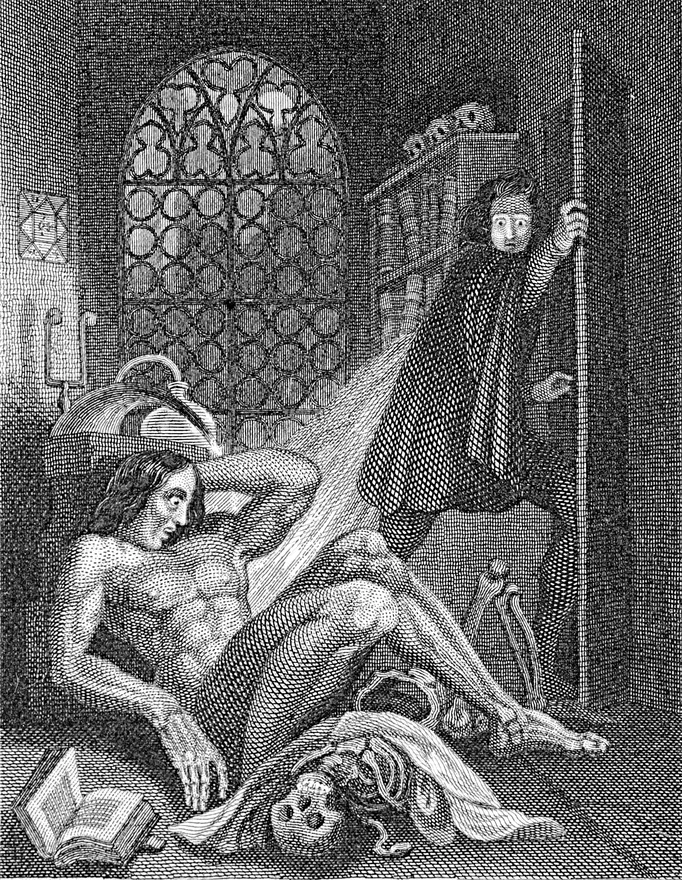
On a dreary November night, Victor sees the end of nearly two years of labour. With an anxiety close to agony, he gathers the instruments of life around him. He means to put a spark of being into the lifeless thing lying at his feet.
It was one in the morning. The rain pattered dismally against the panes, and his candle had almost burnt out.
“I saw the dull yellow eye of the creature open; it breathed hard, and a convulsive motion agitated its limbs.” (Chapter 5)
A Face Chosen to Be Beautiful
How can he describe what he felt at that moment, Victor asks. He had made the limbs in proportion and chosen every feature to be beautiful. Beautiful! He repeats the word to himself.
The yellow skin barely covered the muscles and arteries beneath. The hair was a glossy, flowing black, and the teeth were pearly white.
But those very riches made the contrast more horrible. The watery eyes were almost the same colour as the dull white sockets that held them. The skin was shrivelled, and the lips were straight and black.
Nothing changes as easily as human feeling, Victor says. For nearly two years he had worked for one purpose only, to put life into a lifeless body. For it he had given up rest and health. He had wanted it with a passion far beyond moderation.
Yet now that he had finished, the beauty of the dream was gone, and breathless horror and disgust filled his heart. Unable to bear the sight of the being he had made, he rushed out of the room.
A Kiss in a Dream
He paced his bedroom for a long time, then, exhausted, threw himself on the bed in his clothes. He did sleep, but the wildest dreams shook him.
In the dream he sees Elizabeth, glowing with health, walking the streets of Ingolstadt. Delighted, he takes her in his arms and kisses her, and her lips turn the colour of death. Her face changes, and he is holding the corpse of his dead mother. A shroud wraps her body, and grave worms crawl in the folds of the flannel.
A Hand at the Curtain
He woke in horror. A cold sweat covered his forehead, his teeth chattered, and his limbs shook.
In the dim yellow moonlight forcing its way through the shutters, he saw the wretch. The miserable monster he had made.
It was holding up the curtain of the bed. Its eyes, if they could be called eyes, were fixed on Victor. Its jaws opened and it muttered sounds he could not make out, while a grin wrinkled its cheeks.
Victor says it may have spoken. But he did not listen. One hand reached out as if to hold him, and he escaped it and ran downstairs.
He took refuge in the courtyard of the house. For the rest of the night he paced in terrible agitation, straining to catch every sound. Each one might be the approach of the demoniacal corpse he had so miserably brought to life.
No mortal could have borne the horror of that face, Victor tells Walton. A mummy brought back to life could not be so hideous. It was ugly even unfinished, but once those muscles and joints could move, it became a thing even Dante could not have imagined.
That night his pulse sometimes hammered in every artery, and at other times he nearly sank to the ground from weakness. Bitter disappointment mixed with the horror. The dreams that had been his food and rest for so long had become a hell. The change was so swift, the ruin so complete.
A Walk That Never Looks Back
At last a wet, dismal morning came. His sleepless eyes found the white steeple and clock of the church of Ingolstadt. It was six o’clock. When the porter opened the courtyard gates, he went out into the streets.
He walked fast, afraid the wretch would appear around every corner. He did not dare go back to his rooms. Rain poured from a black sky and soaked him through, but he could not stop walking.
He hardly knew where he was going or what he was doing. He remembers a passage from Coleridge’s Rime of the Ancient Mariner. A man on a lonely road looks back once and never turns his head again, because he knows a frightful fiend is walking close behind him.
A Coach from Switzerland
Walking on like this, he came to the inn where the coaches stopped. Without knowing why, he paused and watched a coach coming toward him from the far end of the street.
It was the diligence from Switzerland. It stopped just where he stood, the door opened, and Henry Clerval saw him and sprang out.
“Frankenstein!” Clerval cried. “I’m so glad to see you! What luck that you’re here the very moment I step down!”
The sight of Clerval brought back his father, Elizabeth and every scene of home. He grasped his friend’s hand and for a moment forgot his horror and misery. For the first time in many months he felt a calm and quiet joy.
Clerval talked all the way as they walked. It had been so hard to persuade his father that there was more to learn than the noble art of bookkeeping. His father kept saying he earned ten thousand florins a year and ate heartily without Greek. Still, in the end his love for his son overcame his dislike of learning.
When Victor asked after his family, Clerval said they were all well, only a little worried that they heard from him so seldom. Then he stopped and looked Victor full in the face. How ill he looked, he said, as if he had been awake for several nights.
Victor answered only that he had been so absorbed in one piece of work that he had not rested. He sincerely hoped it was all over now and he was free.
The Empty Room
He was trembling badly. He could not bear to think about the night before, let alone speak of it. As they reached his lodgings, a thought struck him. The thing he had left in his rooms might still be there, alive and walking about.
He dreaded seeing the monster, but he feared even more that Henry would see it. He asked Clerval to wait a few minutes at the foot of the stairs and dashed up to his rooms.
His hand was already on the lock before he came to himself. Like a child expecting a ghost behind a door, he flung it open. Nothing was there. The sitting room was empty, and so was the bedroom.
He could hardly believe such good fortune. Once he was sure his enemy had really fled, he clapped his hands for joy and ran down to Clerval.
Laughter and a Fit
A servant brought breakfast, but Victor could not keep still. His skin tingled and his pulse raced. He leapt over the chairs, clapped his hands and laughed out loud.
At first Clerval thought he was simply glad to see him. But looking closer, he saw a wildness in Victor’s eyes he could not explain. That loud, unrestrained, heartless laughter frightened him.
“Victor,” Clerval cried, “for heaven’s sake, what’s wrong? Don’t laugh like that. You’re really ill! What is all this?”
Victor covered his eyes with his hands. He thought he saw the dreaded spectre glide into the room. “Don’t ask me. He can tell you. Oh, save me! Save me!”
Imagining the monster had seized him, he struggled wildly and fell down in a fit.
The One Who Reached and the One Who Ran
This is the most famous scene in the book. Yet in the original there is no lightning that night, and no voice crying that it lives. In a room with a dying candle a yellow eye opens, and its maker leaves the room to try to sleep.
A few hours later the newborn being comes to its maker’s bedside, lifts the curtain and reaches out a hand. Victor says it may have said something, and that he did not listen.
The words Victor uses for it change as the night goes on. The lifeless thing, the creature, the wretch, the monster, the demoniacal corpse, and finally, his enemy.
In the morning the rooms are empty, and Victor claps his hands. Where the being went, what it ate, or where it slept, this chapter never says.
When something I longed for finally arrived, did I ever feel something other than joy, and if so, what was it?