Cide Hamete Benengeli begins the second part of this story like this. For nearly a month the curate and the barber stayed away from Don Quixote. They were afraid of reminding him of what had happened.
Still, the two of them often called on the niece and the housekeeper and told them to give him food that would strengthen his heart and his brain. According to the niece and the housekeeper, he was coming back to his senses a little more every day.
The curate and the barber were glad, thinking it had been the right thing to bring him home on the oxcart. So they decided to visit him and test whether he had really recovered. Only, they agreed not to say a single word about knight errantry. They were afraid of reopening a wound that had just begun to heal.
A man dried like a mummy
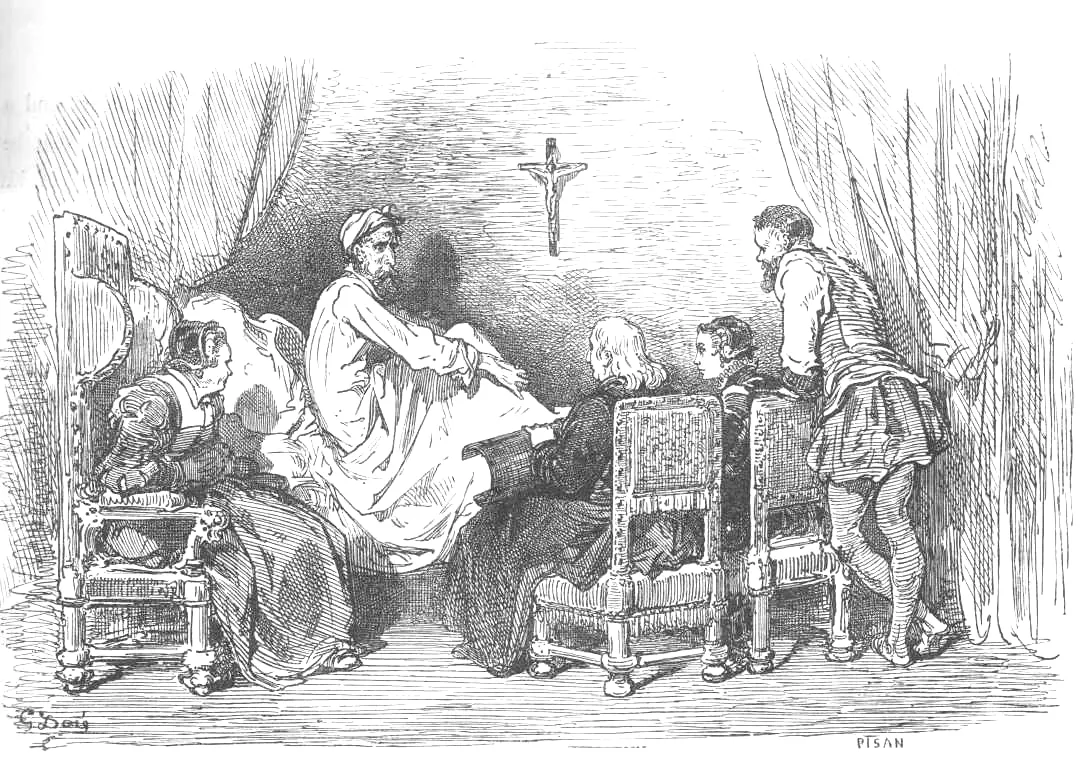
He is sitting up in bed. He wore a green woolen vest and a red Toledo cap, and he was so thin he looked like a mummy made of flesh.
He welcomed the two of them warmly, and when they asked how he was, he answered in calm, dignified words. The talk soon turned to how a realm should be run. The three of them fixed this abuse and abolished that custom, each becoming a maker of new laws.
The narrator notes that it was as if they had put the realm into a forge and pulled out a new one. All the while Don Quixote reasoned so soundly that the two who had come to test him believed he was completely well.
The niece and the housekeeper, at his side, thanked God over and over.
The Turkish fleet
But the curate changed his mind about his promise. He wanted to find out once and for all whether Don Quixote was really cured. So he brought up some news from the court. The Turk was coming down with a great fleet, and no one knew where he meant to strike.
Don Quixote spoke. “His Majesty has acted wisely in having the coasts guarded in good time. But if he would take my advice, I could tell him of a safeguard he would never dream of just now.”
As soon as he heard that, the curate muttered to himself. Poor Don Quixote seemed to be tumbling from the high peak of his madness into the deep pit of his foolishness. May God keep hold of him.
The barber asked what the safeguard was. Don Quixote said he worried that if he spoke here and it reached the royal councillors’ ears by morning, someone else would take the credit for his work. The barber swore he would tell no king and no one at all, and the curate vouched for him.
Only then did Don Quixote reveal it. “His Majesty need only set a day and summon to court every knight errant wandering through Spain. Even if only six came, one of them could break the Turk’s power single-handed. How many books tell of one knight routing an army of two hundred thousand?”
His niece cried out. “Oh no, my uncle wants to be a knight errant again!”
“A knight errant I shall die. Let the Turk come down whenever he likes and as hard as he can, God knows what I mean.”
The madman of Seville
Then the barber says he has a short story that fits this moment perfectly and asks to tell it.
In the madhouse at Seville a man with a university degree was locked up. After some years he decided he had recovered his wits and wrote the archbishop several sensible letters. His relatives, he said, were keeping him there as a madman so they could have his property.
The keeper told the chaplain the archbishop sent that the man often talked sensibly but in the end always poured out nonsense. Yet in more than an hour of talk with the chaplain, he did not say one crooked word. The keeper objected, but the chaplain decided to take him out.
Before leaving he went to say goodbye to his companions. Then a madman in the cage across the way shouted. He was Jupiter, god of the sky, he said, and for the sin of letting that man out he would send no rain on Seville for three years.
Hearing this, the man with the degree took the chaplain by the hand. “Don’t worry. If that fellow is Jupiter and won’t send rain, I am Neptune, god of the sea, and I’ll send rain whenever I please.”
The chaplain told Master Neptune it would be better not to anger Master Jupiter and to stay at home. Everyone laughed, and the man was undressed and stayed in the madhouse.
I am not Neptune
Don Quixote caught its meaning at once. “So this is the story that fit so perfectly you could not keep from telling it, master barber? Comparing wit with wit and valor with valor always breeds ill will. I am not Neptune, god of the sea. I only labor to make the world see its error in not reviving the happy age of knight errantry.”
Knights these days, he said, rustled more with silk than with armor. There were no longer knights who slept in the open fields, nor any who leapt into a boat without oars or sail.
Then he added one more thing. “If that Jupiter will not send rain, here I am, and I will send it. I say this so that Master Basin may understand me.”
The barber said he had meant nothing of the kind and asked him not to take offense, and Don Quixote replied that he himself knew whether he was offended or not.
A man who saw Amadís
This time the curate said there was something weighing on his conscience. He simply could not believe that the knights errant Don Quixote had listed were ever people of flesh and bone. It was all invented, he said, dreams told by men who were awake.
Don Quixote said that too was an error many had fallen into. “That truth is so certain that I could almost say I saw Amadís with my own eyes. He was tall and fair, with a black beard, but well kept. His gaze was gentle yet stern, he spoke little, was slow to anger and quick to let it go.”
The barber asked how big the giant Morgante must have been. Don Quixote said he could not have been all that big. His story mentions many times that he slept under a roof. If he could find a house to fit in, he was not enormous.
Enjoying all this nonsense, the curate went on to ask about the faces of other knights. Meanwhile, the housekeeper and the niece start shouting loudly in the courtyard.
A fight at the door
Sancho is trying to come in to see his master, and the two of them are blocking the door.
The housekeeper shouted first. “What does this vagabond want in this house? Go back to your own. You’re the one who lures our master off and drags him around those wild places.”
Sancho did not give in. “Satan’s housekeeper! The one lured off and dragged around was me, not your master. He’s the one who tempted me out of my house by promising me an island. I’m still waiting for that island.”
The niece asked whether an island was something to eat. Sancho said it was not for eating but for governing, and better than four cities.
Afraid Sancho would blurt out something shameful, Don Quixote hushed the two women and let him in. Seeing this, the curate and the barber gave up hope of his ever recovering and left the house.
The curate said to the barber. “You’ll see. When we least expect it, our gentleman will be off again. It seems the master’s madness is not worth a penny without the servant’s foolishness. You’d think the two were cast in the same mold.”
The head and the limbs
Don Quixote took Sancho into his room and shut the door. “Sancho, it grieves me that you say I lured you from your house. We set out together and we traveled together. If you were tossed in a blanket once, I have been beaten a hundred times. That is where I am ahead of you.”
“That’s only fair. By what you say, master, misfortune sticks to knights more than to squires.”
Don Quixote said that when the head aches, every limb aches too. He was the head and Sancho the limbs, so his pain was Sancho’s and Sancho’s was his.
Sancho answered. “That’s how it ought to be. But when I was being tossed in the blanket as a limb, my head stayed behind the wall and just watched me sail through the air. Without a single ache.”
Don Quixote said that at the time he had suffered more in his spirit than Sancho had in his body. They would talk about that later, he said, and asked what the people of the village were saying about him.
His name as it stands
He told Sancho to report exactly what he had heard, neither puffing up the good nor trimming the bad. If truth stripped of the clothes of flattery ever reached the ears of princes, he said, the world would be a different place.
Sancho said he would, if his master would not get angry. Don Quixote said he would not and that Sancho could speak freely. “Then here it is. People take you for a very great madman, master, and me for no less of a fool. The country gentlemen say that with four vines and two strips of land you’ve stuck a ‘Don’ on your name and set up as a knight.”
Sancho passed on more of what people said. Some say “mad, but funny,” and some say “brave, but unlucky.” There were also those who said “courteous, but a nuisance.”
Don Quixote said slander always follows wherever virtue stands high. Even Julius Caesar and Alexander had their faults picked at. If that was all they said of him, it could be borne.
“That’s not all. So far it’s only crumbs. The tail still has to be skinned.”
An author named Eggplant
This is what Sancho told him. Bartolomé Carrasco’s son had come back from Salamanca last night as a bachelor. When Sancho went to welcome him, he said the story of his master was already out in a book.
The book’s title was The Ingenious Hidalgo Don Quixote of La Mancha. Sancho appeared in it under his own name, and so did Dulcinea.
“Even things we did when it was just the two of us are written down, he says. I crossed myself in fright, wondering how the man who wrote it could know.”
“Sancho, the author of that book must surely be some wise enchanter. Nothing can be hidden from such men.”
Sancho tilted his head. “I don’t know about an enchanter. The bachelor says the author’s name is Cide Hamete Berenjena.”
Don Quixote said that was a Moorish name. Sancho said that since Moors are said to love eggplant, it made sense. Don Quixote told him he must have misheard, and explained that Cide means “lord” in Arabic.
He asked Sancho to bring the bachelor at once. Until he had heard it all, he said, nothing he ate would have any taste. Sancho runs off as if he had wings.
The kneeling bachelor
While he waited for Sancho, Don Quixote fell into thought. The blood of his enemies had not yet dried on his sword, and already his deeds were in print. He could hardly believe it.
He thought some sage must have done it by magic. A friend would have written to puff up his deeds, an enemy to tear them down. But it bothered him that the author was a Moor. He worried that the book might have told Dulcinea’s story without proper decency.
Sancho comes in with the bachelor. The bachelor’s name was Sansón, but he was not big. He was about twenty-four, round in the face, flat in the nose and wide in the mouth. The narrator notes that all of these were signs of a man who loved pranks and jokes.
The moment he saw Don Quixote, he drops to his knees. “Give me your illustrious hands, Don Quixote of La Mancha. You are the most famous knight errant there ever was or ever will be on this earth. Blessed be Cide Hamete Benengeli, who wrote down your great deeds. And twice blessed be the man who had them put from Arabic into our own tongue!”
Don Quixote raised him to his feet. “So a history of me truly exists, and a Moorish sage is its author?”
“As true as true can be. I’d say more than twelve thousand copies have been printed so far. They were printed in Portugal, Barcelona and Valencia, and there’s word it’s being printed in Antwerp too. Before long there won’t be a nation or a language it hasn’t been translated into.”
The parts readers picked
Don Quixote said nothing pleased a virtuous man so much as being printed in a book with a good name while still alive. It had to be a good name, he said. Then he asked which of his deeds the book praised most.
Sansón said opinions differed just as tastes did. Some pick the windmills that seemed to be giants. Some pick the fulling mills, some the two armies that turned into flocks of sheep, some the dead man being carried to Segovia. Some say freeing the convicts beats all the rest, and some say nothing equals the fight with the Biscayan.
Sancho broke in. “Is the business with the Galician horse drivers in there too? The day our Rocinante went after what he couldn’t have?”
“The sage left nothing in the inkwell. He wrote it all down. Even the capers good Sancho cut on the blanket.”
“I didn’t cut any capers on the blanket. I cut them in the air. A lot more than I wanted to.”
The poet and the historian
Sansón said there was something a few readers regretted. They wished the author had forgotten a few of the many times Don Quixote was beaten.
Sancho was quick to answer. “That’s where the truth of the story is. Take out the beatings and it’s a different story.”
Don Quixote thought otherwise. If a passage did not change the truth of the story and only belittled its hero, he said, it could fairly have been left out. Aeneas was not as devout as Virgil painted him, nor Ulysses as wise as Homer made him.
Sansón answered.
“…el poeta puede contar, o cantar las cosas, no como fueron, sino como debían ser; y el historiador las ha de escribir, no como debían ser, sino como fueron, sin añadir ni quitar a la verdad cosa alguna.” …a poet may recount or sing of things as they ought to be rather than as they were. A historian must record them as they were, not as they ought to be, with nothing added to the truth and nothing taken from it. (Part II, Chapter 3)
If that Moorish gentleman really told only the truth, Sancho said, his own beatings would be written down right next to his master’s. Every time they measured his master’s back, they had measured all of Sancho.
“You are a sly one, Sancho. You remember well enough when you want to.”
“Even if I wanted to forget the cudgeling, the bruises on my ribs won’t let me. They’re still black and blue.”
The second person in the book
Sancho said he had heard that he too was one of the principal “presonages” in the book. When Sansón corrected him, “personages, not presonages,” Sancho grumbled that now there was one more person correcting his words.
Sansón said Sancho was certainly the second person of the story. Some readers even liked hearing Sancho talk more than anyone else in it. Some said, though, that he had been too trusting to believe he could really get that island.
Don Quixote spoke. “There is still sun on the garden wall. As Sancho grows older and gains experience, he will be far better fit to be a governor than he is now.”
“If I can’t govern an island at the age I am now, I won’t govern it at Methuselah’s age either. The trouble is that the island is dawdling somewhere, not that my head isn’t up to it.”
Still, Sancho says he is glad the book did not write about him unpleasantly. If it had said things that were hard to hear, he would have shouted loud enough for the deaf to hear. Everyone, he said, should be careful how they speak and write about others.
This is a rooster
Sansón passed on one more fault. The author had stuck in a novel called The Tale of Reckless Curiosity. Not because it was badly written, but because it was out of place and had nothing to do with Don Quixote’s story.
At that, Don Quixote changed his mind. “Then the author of my story is no sage, but some chatterer who wrote whatever came out, without a thought. Like Orbaneja, the painter of Úbeda. When asked what he was painting, he would say ‘whatever comes out.’ When he painted a rooster, it looked so little like one that he had to write ‘This is a rooster’ beside it. If my story is like that, it will need a commentary to be understood.”
Sansón said it was nothing of the kind. “The book is so plain there’s nothing hard in it at all. Children handle it, young people read it, adults understand it and the old sing its praises. The moment people see a skinny nag, they say, ‘There goes Rocinante.’”
The ones who read it most, he said, were the pages. There was no lord’s antechamber without a copy, and as soon as one person put it down another picked it up.
Who stole the donkey
Don Quixote said that a book about him must have pleased very few people. Sansón said it was the opposite, that countless people had enjoyed it, but some did fault the author’s memory.
“The author forgot to say who the thief was that stole Sancho’s donkey. That it was lost can only be guessed from what comes before and after, and not long after, there’s Sancho riding that same donkey again. And what Sancho did with the hundred gold crowns he found in the bag in the Sierra Morena is never mentioned again.”
It was in the very gap the first part never wrote a line about that the readers of the book had stumbled too.
Sancho said he was in no mood to settle accounts just now. His stomach was so empty that if he didn’t have two swallows of old wine he would keel over. He would come back after eating and answer everything, the donkey and the gold alike, and without waiting for a reply he went home.
Don Quixote kept the bachelor to lunch. At the table they talked of chivalry, and Sansón played along.
Four stakes
After the siesta, Sancho comes back. “You wanted to know when and how and who stole my donkey. It was the very night we went into the Sierra Morena to get away from the patrol, after we freed the convicts. You leaned on your lance, master, and I fell asleep on my donkey as if on four feather mattresses.”
Someone came along and set four stakes under the four corners of the packsaddle. Then, leaving Sancho sitting on the packsaddle just as he was, he pulled the donkey out from under him.
Don Quixote said that was no wonder. At the siege of Albraca, the famous thief Brunello had used the same trick to pull Sacripante’s horse out from between his legs.
“At daybreak I gave a little wriggle, the stakes slipped out, and down I went to the ground with a thump. I looked for my donkey, but it wasn’t there. If the author didn’t write down the lament I made then, crying, he didn’t write down anything good in that book.”
A few days later, traveling with the Princess Micomicona, he recognized his donkey. The man riding it, dressed as a gypsy, was Ginés de Pasamonte, whom they had freed from the chain. That lying scoundrel, yes.
Sansón says the mistake is not there. It is that the author had Sancho riding the donkey before he had even got it back.
Sancho said he had nothing to say to that. “Either the historian got it wrong, or the printer slipped up.”
A hundred gold crowns
The hundred gold crowns, he said, he had spent on himself, his wife and his children. Because of that money his wife had put up with all his wandering. “If you counted the beatings I got at just four maravedís a blow, a hundred crowns wouldn’t pay me half. What anyone brought home or spent is nobody else’s business. Everyone is as God made him, and often worse.”
Sansón said he would tell the author not to leave this out the next time the book was printed, and that the book would be all the better for it.
Don Quixote asked whether the author had also promised a second part.
Sansón said he had promised, but had not yet found whoever had the story. Besides, there was a saying that no second part was ever any good. Still, the cheerful readers said, “Let Don Quixote charge and Sancho talk, and that will do.”
Sancho spoke. “That Moorish gentleman must think we’re lying around in the straw here, just sleeping. We’ll give him so many adventures that he can write not just a second part but a hundredth.”
A second road
Before Sancho had even finished, Rocinante’s neighing comes to their ears. Don Quixote took it as a good omen and decided to set out again in three or four days.
Sansón advised him to go to Aragon and enter the tournament at Zaragoza for the feast of Saint George. At the same time, he told him to be a little more careful about dangers. His life was not his own, he said, but belonged to everyone who needed his help.
Sancho took that up. “That’s exactly what I can’t stand. My master goes at a hundred armed men the way a greedy boy goes at a melon. There’s a time to charge and a time to pull back. Between the coward and the reckless lies courage, you said so yourself, master.”
He set his conditions. His master was to do all the fighting, and he would only look after his master’s clothes and meals. He wanted to be known not as a famous fighter but as the most loyal squire there ever was. “If you give me an island, master, I’ll take it gratefully. If you don’t, I was born Sancho and I’ll die Sancho.”
Sansón said he had spoken like a professor. Only, a post changes a man, he said, and once Sancho was a governor he might not even know the mother who bore him. Sancho said that would never happen, since his soul was coated four fingers thick with the fat of an old Christian.
Don Quixote asked Sansón for a poem. It was to bid farewell to Dulcinea, and the first letters of its lines had to spell out “Dulcinea del Toboso.” Sansón said the letters did not come out even and it would be hard, but he would try.
They set the day of departure for eight days later. Don Quixote asked him to keep it secret from the curate and the barber, the niece and the housekeeper, and Sansón promised.
The people who read the book first
In this chapter Don Quixote and Sancho met their readers for the first time. Those readers knew even what the two of them had done when they were alone. Whether that was because the author really was an enchanter, no one knows.
The readers picked the parts they loved, wished the beatings had been trimmed, and found the gaps. Don Quixote worried about how the book had written him, and Sancho filled the gap with his own mouth.
And the people waiting for them on the road already know them, well enough to call any skinny nag Rocinante.
Have you ever read something someone wrote or said about you, and wanted to correct that part afterward?