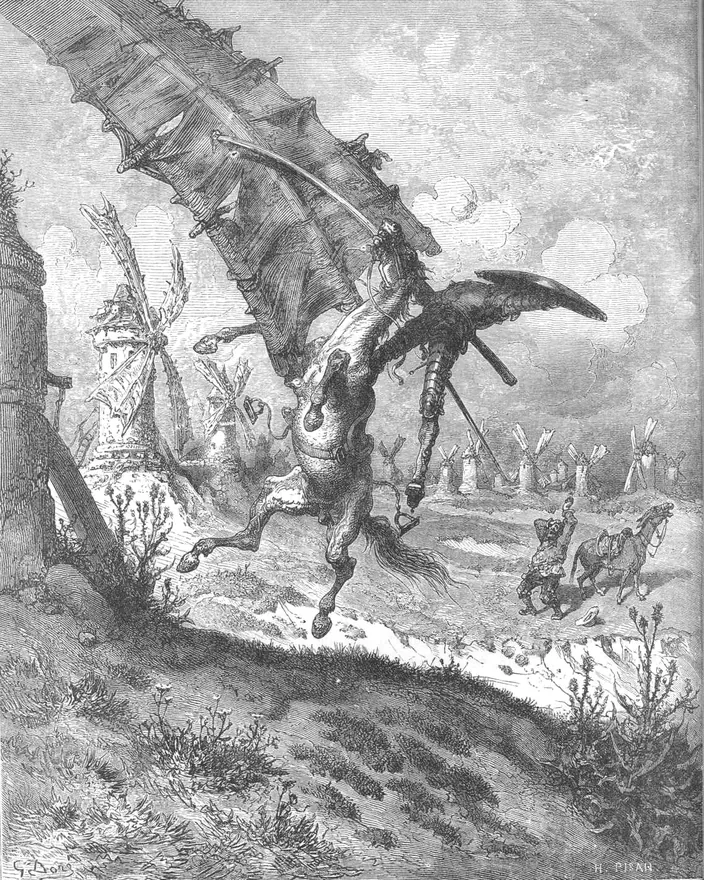
As the two of them rode across the plain of Montiel, talking as they went, windmills came into view. There looked to be thirty or forty of them, and the narrator says that just as many stand on that plain to this day.
The moment Don Quixote saw them, he called to his squire. Luck, he said, was steering their affairs better than they could have wished. Then he pointed across the plain.
“…ves allí, amigo Sancho Panza, donde se descubren treinta, o pocos más, desaforados gigantes…” Look over there, Sancho Panza my friend, where thirty of them, or a few more, are showing themselves, giants beyond all measure… (Part I, Chapter 8)
He meant to fight those giants and take the life of every last one of them. With the spoils they won, the two of them would begin to grow rich. To sweep such evil seed off the face of the earth was a just war, he said, and a great service to God.
The ones with the long arms
Sancho asked. “Giants? What giants?”
“Those long-armed fellows you see over there. Some of their kind have arms nearly two leagues long.”
Sancho narrowed his eyes and looked again, but however hard he looked, there were no giants. “Look closely, master. Those things over there aren’t giants, they’re windmills. What look like arms are the sails, and when the wind turns them, the millstone goes round.”
Don Quixote looked at his squire as if he pitied him. “It seems you are not yet at home in the business of adventures. Those are giants. If you are afraid, stand well aside and say your prayers. Meanwhile I shall join them in a fierce and uneven fight.”
The words were hardly out of his mouth before he set spurs to Rocinante.
Behind him Sancho shouted at the top of his voice. What his master was about to charge, he cried, were windmills for certain, not giants. But Don Quixote believed far too firmly that they were giants. He did not hear his squire’s cries, and even close up he did not see what they were.
Instead he shouts aloud as he rides. “Flee not, base and cowardly creatures! It is a single knight alone who comes against ye!”
Just then a little wind rose and the great sails slowly began to move. Seeing it, Don Quixote shouted again. “Though ye swing more arms than the giant Briareus, ye shall pay for this, and pay in full!”
A lance caught in a sail
He gave himself to his lady Dulcinea with all his heart and begged her to aid him in this perilous hour. Covered by his round shield, lance tucked under his arm, he drives Rocinante straight at the first windmill.
The point of the lance stuck fast in a sail.
At that instant the wind swung the sail round hard. The lance flew to pieces, and the sail dragged horse and knight along with it. The knight went rolling across the field, badly battered.
When Sancho came up, pushing his donkey as fast as it would go, his master could not move. The shock of going down with Rocinante had been that hard.
Sancho dropped down beside him and groaned. “Oh, God help us! Didn’t I tell you to look before you leapt, that those were only windmills? No one could miss it unless he had windmills turning in his own head.”
What the enchanter changed
“Quiet, Sancho my friend.”
Don Quixote spoke without getting up. The affairs of war, he said, are more given to constant change than anything else. Then he told Sancho the truth as he knew it. “To my mind, and this is plain fact, that wise Frestón who stole my room and my books has changed these giants into windmills. He means to rob me of the glory of defeating them, so deeply does he hate me. Yet at the last, all his wicked arts shall count for little against the rightness of my sword.”
Sancho’s answer was short. “God will do what He can.”
He helped his master up and set him back on Rocinante, whose own shoulder was half out of joint.
A lance to be torn from an oak
Talking over the adventure they had just had, the two of them took the road for Puerto Lápice. So many travelers passed that way, by Don Quixote’s account, that adventures of every kind were bound to be found there.
Still, the loss of his lance weighed on him, and he brought it up with his squire. “I recall a story I once read. A Spanish knight named Diego Pérez de Vargas broke his sword in battle and tore a heavy branch from an oak. With it he pounded so many Moors that day that he won the nickname Machuca, and from then on he and his descendants were called Vargas y Machuca.”
He too, he said, would tear an equally fine branch from the first oak he came to. The deeds he would do with it would be hard for others to believe, and Sancho would count himself lucky to have come along to see them.
Sancho nodded, but he never took his eyes off his master’s body. “It’s in God’s hands, and I believe every word you say, master. But sit up straight a bit. You must have been badly hurt in that fall, because you’re leaning to one side.”
A knight does not say it hurts
Don Quixote readily agreed. But there was a reason, he said, why he did not speak of pain. “A knight errant is not permitted to complain of any wound he takes. Not even if his guts were spilling out through it.”
Sancho saw it differently. “Then I’ve nothing to say to that. All the same, I’d like you to say so when something hurts you, master. As for me, I’m going to say so over the smallest ache. Unless that law about not complaining reaches as far as squires.”
His squire’s simplicity made Don Quixote laugh in spite of himself. Then he told Sancho he might complain as much as he liked, whenever he liked. He had not yet read a single passage in the rules of chivalry that forbade it.
The squire with his wineskin raised
When Sancho said it was time for a midday meal, Don Quixote answered that he had no appetite yet, so Sancho should eat whenever he pleased.
With leave given, Sancho settles himself on his donkey as comfortably as he can. He takes food from the saddlebags and eats as he ambles along behind his master, now and then lifting the wineskin for a swallow. He drank with such relish that the most pampered tavern keeper in Málaga might have envied him.
Sipping as he went, Sancho did not think of a single promise his master had made. Riding about in search of adventures, however dangerous, struck him not as hard work but as a very pleasant rest.
The night he did not sleep
That night they stopped among some trees. Don Quixote broke off a dry branch from one of them that would do for a lance, and fitted the iron head from his broken lance onto its end.
He did not sleep a wink all night. He was thinking of his lady Dulcinea, and that too was just as he had read. The knights in his books spent many nights awake in forests and empty country, longing for their ladies.
Sancho did not spend the night that way. His belly was full, and not with chicory water taken as medicine, so he slept the whole night through in one go. Had his master not called him, neither the sun shining on his face nor the songs of the many birds merrily greeting the new day would have woken him.
As soon as he was up, Sancho reached for his wineskin and found it a little thinner than the night before. Seeing no way to make up the shortfall any time soon, he was heavy at heart.
Don Quixote would not take breakfast either, because, the narrator says, he had become a man who lived on sweet memories.
The two of them set off once more on the road to Puerto Lápice.
The windmill won, and he did not lose
In this chapter the two of them looked at the same plain. Don Quixote saw thirty-odd giants with long arms, and Sancho saw windmills whose sails turned in the wind.
This time Sancho’s eyes were right. The lance caught in the sail and broke, and horse and knight rolled across the field.
Yet when Don Quixote gets up, he does not admit defeat. What he hit was indeed a windmill, he says, but a moment earlier that windmill had been a giant. The enchanter who stole his library changed its shape at the last instant to rob him of the glory. The moment he says so, both pairs of eyes are right. The windmill Sancho saw was real, and so was the giant he saw.
Nothing that happens from now on can break that explanation. Whatever the next giant looks like, he need only say an enchanter changed it.
Sancho neither argued with that explanation nor agreed with it. God will do what He can, he said, and he simply helped his master to his feet.
And what he sees is still different. When his master speaks of the glory of Machuca, Sancho sees his master’s body tilting to one side. When his master lies awake longing for Dulcinea, Sancho sees how much thinner the wineskin has grown.
The giants have not vanished from Don Quixote’s eyes. They have only been enchanted into windmills.
Have you ever told a friend you thought they were wrong and then stayed by their side to the end anyway?