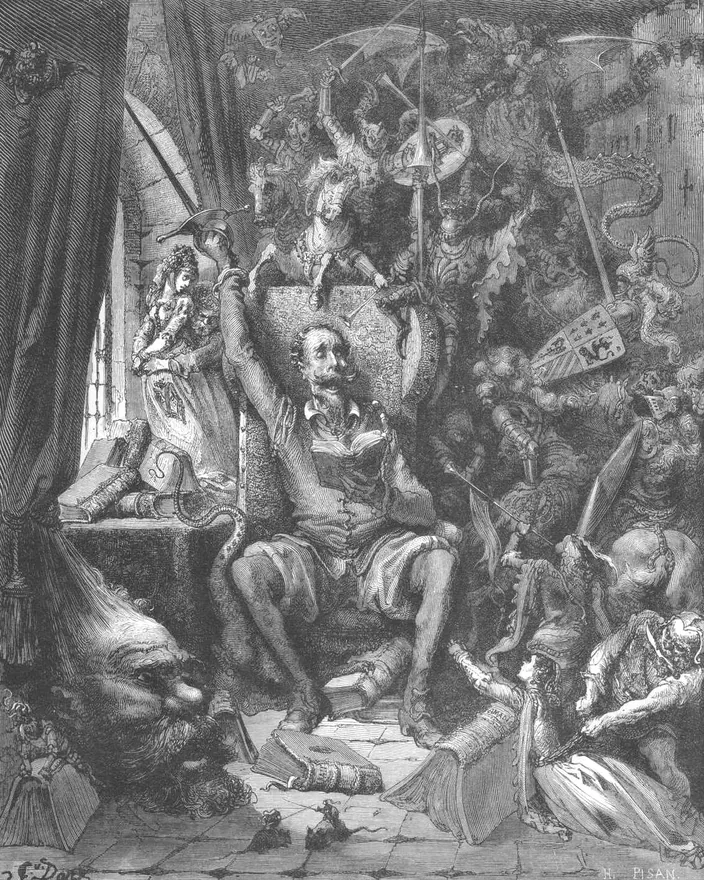
In a village of La Mancha there lived a country gentleman. The person who tells this story says he would rather not remember the name of that village. He never says why.
“En un lugar de la Mancha, de cuyo nombre no quiero acordarme, no ha mucho tiempo que vivía un hidalgo…” Somewhere in La Mancha, in a village whose name I would rather not remember, there lived not long ago a country gentleman… (Part I, Chapter 1)
On the wall of his house hang a lance on its rack and a worn leather shield. In the stable stands a horse that is all skin and bone, and in the yard runs a quick hunting dog.
His meals never change. At midday there is a stew with a little more beef than mutton in it, and in the evening, most nights, leftover meat chopped and dressed. On Saturdays he fries eggs with bacon, on Fridays he eats lentils, and on Sundays a pigeon appears as a treat. That alone used up three quarters of his income.
What was left went on clothes. On feast days he wore velvet breeches with slippers of the same cloth. On ordinary days he kept up appearances in the finest of the rough homespun.
Who lives in the house
With him live a housekeeper past forty and a niece not yet twenty. There is also a lad who saddles the horse and prunes the trees.
The master of the house was close to fifty. He was sturdy in frame but lean in flesh and thin in the face, an early riser and a lover of the hunt.
Some say his surname was Quijada, others Quesada. Even those who wrote down these events disagree, though a reasonable guess suggests it was Quejana. The narrator adds that this hardly matters to the story. It is enough that the telling never strays an inch from the truth.
Books bought with fields
He had a great deal of idle time. That was most of the year, and he spent it reading books of chivalry.
He was so absorbed that he nearly forgot the hunting he loved and forgot to look after his estate as well. In the end he sold several fields of grain to buy books of chivalry. He brought home every one he could lay his hands on.
The ones he treasured most were by an author named Feliciano de Silva. The more twisted and knotted the sentences, the more they shone like pearls in his eyes. Whenever he met a line like this in a love letter or a challenge to a duel, he read it again and again.
“The reason of the unreason inflicted on my reason so wears down my reason that I am right to complain of your loveliness.”
The poor man loses sleep clinging to sentences like these. He struggles all night to dig out their meaning, though Aristotle himself, raised from the dead for that one task, could not have dug it out.
He worried about the people in the books, too. A knight called Belianis gave and took so many wounds. However skilled the healers who treated him, the gentleman fretted, his face and body must be covered in scars.
He did like the way that book ended by promising an adventure that would never end. Many times he wanted to take up a pen and write the ending himself. If larger and more constant thoughts had not stopped him, he really would have.
He often argued with the village curate, too. The curate was a learned man with a degree from Sigüenza, and the two of them disputed which knight was greater. The curate named Palmerin of England, and the gentleman named Amadis of Gaul.
Then Nicolás, the village barber, would cut in to say that neither came close to the Knight of the Sun. If anyone could be compared to him, it was Amadis’s younger brother Galaor. He was neither fussy like his brother nor a crybaby, the barber said, and he was every bit as brave.
A brain dried to dust
And so he buried himself in books. At night he read until the sky grew light, and by day he read until it grew dark.
With so little sleep and so much reading his brain at last dried up completely, and he lost his wits.
What he had read filled his head just as it was. Magic and quarrels, battles and duels, wounds and words of love and storms, and impossible nonsense, all of it. Once he came to believe that every one of those invented tales was true, there was no history in the world more certain to him.
He would say that the Cid had been a fine knight, but nothing beside the Knight of the Burning Sword, who cut two giants in half with a single stroke. He praised the giant Morgante, who alone was gentle and well mannered among a race of giants who were all arrogant and rude. And to give the traitor Ganelon a good kicking, he would have handed over his housekeeper and thrown in his niece as well.
The strangest thought in the world
His wits now completely gone, he arrives at a stranger thought than any madman in the world has ever had. He must become a knight errant.
He will put on armor, mount his horse and ride through the whole world in search of adventure. He will do everything he has read that knights errant do. He will right the wrongs done to the injured, throw himself into danger and overcome it, and so win a name that lasts forever.
That, he thought, was the way to raise his own honor and to serve his country. The poor man already pictured himself crowned, by the strength of his own arm, with nothing less than the empire of Trebizond.
A visor made of pasteboard
The first thing he did was clean his armor. It had belonged to his great-grandfathers and had lain in a corner of the house for centuries, rusted and spotted with mold.
Once it was cleaned and mended, he found one great flaw. It was not a helmet with a visor to cover the face, only an iron cap that covered the head. He made half a visor out of pasteboard and fitted it to the cap, and then it looked quite like a whole helmet.
To see whether it would hold, he drew his sword and struck, and a week’s work fell to pieces at the very first blow.
It troubled him that it had broken so easily. This time he rebuilt it with a few iron bars inside, and he was satisfied that it was strong enough.
And he never tested it again. He decided to regard it as the finest helmet anyone could wish for.
A name that took four days
Next came the horse.
Its hooves were cracked and it had more faults than the horse in the old joke that was nothing but skin and bones. Yet in his eyes neither Alexander’s Bucephalus nor the Cid’s Babieca could compare with it.
Naming it took four days. It made no sense, he thought, for the horse of so famous a knight, and so fine a horse besides, to go without a famous name. When the master changes his station, the horse must change its name as well. It had to be a grand and ringing name that showed both what the horse had been before it was a knight’s horse and what it was now.
After making up names, rubbing them out, adding to them and pulling them down again and again, he called the horse Rocinante.
A rocín is a sorry working horse, and ante means both “before” and “foremost.” Once a sorry nag, now the foremost of all horses in the world. To his ear it was a lofty, ringing name full of meaning.
Choosing his own name took eight more days. He decided to call himself Don Quixote.
Then he remembered the valiant Amadis. Amadis had not been content with his name alone but had added the name of his country and been called Amadis of Gaul. So he too added the name of his homeland and became Don Quixote of La Mancha. That way, he believed, he would make his family and birthplace plain and bring honor to his homeland besides.
A tree without leaves
Armor cleaned, iron cap turned into a helmet, names given to his horse and to himself, only one thing remained. A lady to love.
A knight errant without a beloved, he thought, was a tree without leaves or fruit, a body without a soul.
He mutters to himself. “Whether for my sins or by good fortune, if I should meet a giant on the road, as befalls knights errant every day, and fell him at a stroke, must I not have someone to send him to? That giant shall go before my gentle lady, kneel, and say in a humble voice, My lady, I am the giant Caraculiambro, lord of the isle of Malindrania. The knight Don Quixote of La Mancha, whom no praise can ever honor enough, has defeated me and commanded me to come before you and await your pleasure.”
He was delighted once he had composed all that. He was more delighted still when he found someone to be his lady.
Not far from his village lives a rather pretty farm girl. He once loved her, though by all accounts she never knew it and never even suspected. Her name is Aldonza Lorenzo.
He decided to make her the mistress of his thoughts. It had to be a name not too far from her own that still sounded like a princess or a great lady. Since she came from El Toboso, he decided to call her Dulcinea of El Toboso. Like the other names he had given to himself and his belongings, it sounded to him musical, rare and full of meaning.
Only the names had changed
Count up what he did in this chapter. He cleaned his rusty armor, and he made a pasteboard visor and made it again when it broke. And he gave new names to three. His horse, himself and a girl from the next village.
Nothing has changed. The horse is still skin and bone. The helmet is untested pasteboard. Aldonza Lorenzo still does not know that she has become anyone’s lady.
To the housekeeper and the niece, to the curate and the barber, he must still be the neighbor close to fifty who sold his fields to buy books.
But in his eyes everything has changed.
He is now Don Quixote of La Mancha, his horse is the foremost of all horses, and he has a lady to serve. Over the same stable, the same armor and the same village, two ways of seeing have begun to see different things. This book walks between them to the very end.
He once wanted to write the ending of a book himself. The narrator wrote that he did not because a larger thought stopped him. What that larger thought was is now clear. Instead of taking up a pen, he decided to walk into the book himself.
Early one hot morning in July, he leaves home without telling anyone.
If you could give yourself a new name, which name would you choose, and what would you want to do with it?