Don Quixote, a country gentleman of La Mancha, read so many books of chivalry that in the end he made himself a knight errant. Now he roams the roads with his neighbor, the farmer Sancho Panza, as his squire.
A few days earlier, when his helmet was smashed in a fight, he swore an oath to the heavens. He would not eat bread off a tablecloth until he took a helmet just as fine from some other knight. And the name he spoke at the end of that oath was the legendary helmet of Mambrino.
The night before, searching for water in the dark, the two of them heard a fearful noise. Through the sound of water came a clanking of iron and something pounding down, blow after blow, in steady time.
Don Quixote wanted to go toward it at once, and Sancho secretly tied Rocinante’s hind legs together to keep his master in that spot all night.
When day came, it turned out to be six great wooden hammers in a mill that pounded woolen cloth by the force of water. The two of them laughed for a long time. But then Sancho began to mock his master by mimicking the big words he had spoken in the night. “I was born in this Age of Iron to bring back the Golden Age.”
Don Quixote struck Sancho twice on the back with the butt of his lance. Then he told him to talk less to his master from now on. No squire in any book, he said, had ever talked to his master as much as Sancho did.
One door shuts, another opens
That morning it began to rain a little. Sancho wanted to take shelter in the mill, but Don Quixote hated that cruel joke so much that he would not go in. The two of them turned off to the right and set out along a road much like the one they had traveled the day before.
Before long Don Quixote saw a man on horseback. On the man’s head something was gleaming like gold. He turned to Sancho at once.
“Sancho, it seems to me every proverb holds true, for every one of them comes from experience, and experience is the mother of all knowledge. Above all the one that says, ‘When one door shuts, another opens.’ Last night fortune fooled us with those hammers and shut the door on the adventure we were seeking, but now it is flinging wide the door to a better and surer one. If I fail to go through it this time, the fault will be mine, not my ignorance of mills or the darkness of the night. Unless I am mistaken, the man coming toward us wears the helmet of Mambrino. The very helmet I swore an oath about.”
“Master, look well at what you say, and look even better at what you do. We don’t want it to be another mill that hammers what’s left of our wits to pulp.”
“The devil take you, man! What has a helmet to do with mills?”
“I don’t know anything. But if only I could talk as much as I used to, maybe I’d have something to say that would show you you’re seeing it wrong.”
What Sancho saw
“How can I be seeing it wrong, you nitpicking traitor! Tell me, do you not see that knight coming toward us on a dappled gray horse, with a golden helmet on his head?”
Sancho looked again. Then he said what he saw. “What I can see is a man on a brown donkey like mine, with something shiny perched on his head.”
“That is the helmet of Mambrino. Stand aside and leave me to face him alone. You will see me finish this adventure without a single word, to save time, and make the helmet I have longed for my own.”
“I’ll see to standing aside. But I say it again, please God, let this turn out sweet herbs and not another mill.”
“I told you not even to think of mills again. I swear… I’ll say no more, but I will pound your very soul like cloth in a mill.”
Afraid his master might really keep the oath he had tossed out, round as a ball, Sancho shut his mouth.
The man keeping out of the rain
Here is what the helmet, the horse and the knight that Don Quixote saw really were, the narrator explains.
There were two villages in those parts. One was so small it had neither an apothecary nor a barber, while the larger one right next to it had both. So the barber of the larger village served the smaller one as well.
That day there was a sick man in the small village who needed his blood let and another man who needed a shave, so the barber set out with his brass basin.
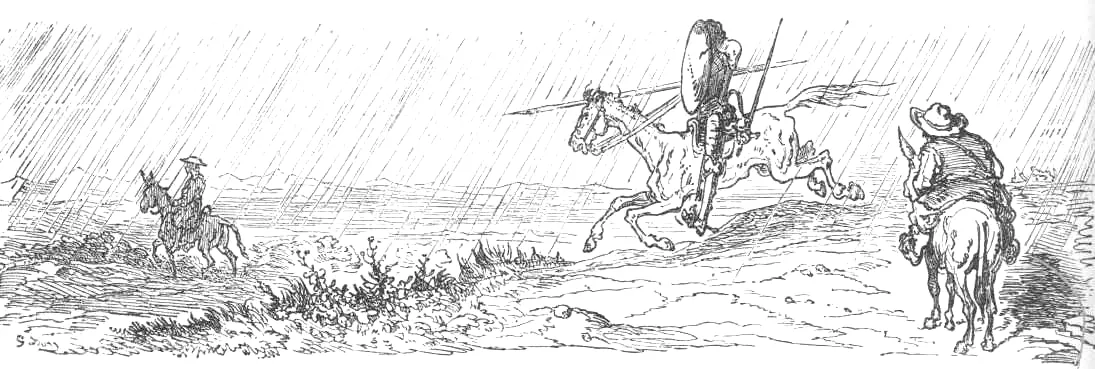
On the way it began to rain. To keep his hat, which seemed to be new, from getting wet, the barber put the basin on his head. The basin had been polished clean, so it shone from half a league away. He was riding a brown donkey, just as Sancho said.
That was why Don Quixote saw a dappled gray horse, a knight and a golden helmet. Whatever he saw, the narrator writes, he fitted it with the greatest ease into the chivalry in his head.
When the poor rider came near, Don Quixote, without a word, drove Rocinante forward as hard as he could. He held his lance low, meaning to run the man straight through. And without slackening his charge, he cries out. “Defend thyself, wretched captive! Or yield up of thine own will what is so justly due to me!”
The barber saw a phantom he had never dreamed of bearing down on him. The only way to escape the lance was to tumble off his donkey. No sooner had he hit the ground than he was up again, quicker than a deer, and racing across the plain so fast the wind could not have caught him.
The basin stayed on the ground. Don Quixote was satisfied with that, and said the pagan had cleverly imitated the beaver. When hunters chase a beaver, he said, it bites off the very thing they are after and runs away.
A helmet with half missing
Don Quixote told Sancho to pick up the helmet. Sancho took the basin in his hands and said: “Well, now, that’s a fine basin. It’ll easily fetch eight reales.”
Don Quixote took it and put it straight on his head. He turned it this way and that, trying to find where it fit, but never managed to. “The pagan for whom this famous helmet was first made must have had an enormous head. And the worst of it is that half of it is missing.”
Hearing the basin called a helmet, Sancho could not hold back his laughter. But then he remembered his master’s fiery temper and stopped halfway.
“What are you laughing at, Sancho?”
“I’m laughing at the thought of how big that pagan’s head must have been, the one who owned this helmet. It looks just like a barber’s basin.”
“Do you know what I think, Sancho? Somehow this famous enchanted helmet fell into the hands of a man who did not know its worth. Seeing that it was pure gold, without knowing what it was, he must have melted down half and sold it. Then from the other half he made this. It has come to look like a barber’s basin, as you say.”
“…para mí que la conozco no hace al caso su trasmutación…” …I know it for what it is, and so its change of shape matters nothing to me… (Part I, Chapter 21)
“At the first village with a forge I shall have it mended, so well that not even the helmet the god of smiths made for the god of war will be its equal. Until then I shall wear it as it is. Something is better than nothing, and it will be more than enough to stop a stone.”
What the back remembers
“As long as it isn’t a stone thrown from a sling. The kind that made the sign of the cross over your molars the day the two armies fought. That stone smashed the can of precious medicine that turned my insides out, too.”
“I am not much sorry to have lost it. I keep the recipe in my head.”
“So do I. But the day I make it again or taste it again will be my last. I’m not going to get into anything where I’d need it, either. I’ll keep all five senses sharp so I neither get hurt nor hurt anyone. There’s no way to stop being tossed in a blanket again, though. When that happens, I’ll just hunch my shoulders, hold my breath, shut my eyes and go wherever luck and the blanket take me.”
“Sancho, you are not a good Christian, for you never forget an injury once done to you. A noble and generous heart pays no mind to such trifles. Did you come away lame, with a broken rib, with a cracked head? When you weigh it, it was a joke and a pastime. Had I not seen it that way, I would long since have taken a revenge for you greater than the Greeks took for their stolen Helen. Had that Helen lived in our day, or had my Dulcinea lived in hers, Helen would never have won the fame for beauty she has now.”
He sighed, and sent the sigh up to the clouds.
“Call it a joke, then, since there’s no real revenge to be had. But I know which part was a joke and which part was real. It won’t fall out of my memory any more than it’ll come off my back.”
Horse or donkey
Sancho changed the subject. “Never mind that, master. What do we do with this dappled gray horse that Martino left behind, the one you knocked down? This horse that looks like a brown donkey, I mean. The way he bolted, I don’t think he’s ever coming back for it. I swear by my beard, it’s a good donkey!”
“I never strip those I defeat. Nor is it the custom of chivalry to take the loser’s mount and leave him on foot, unless the victor lost his own in the fight. In that case it is lawful to take the loser’s as fairly won in battle. So, Sancho, leave that horse, or donkey, or whatever you care to call it, right where it is. When its owner sees we have gone, he will return for it.”
“God knows how much I’d like to take it. Or swap it for mine, at least, because mine isn’t as good as this one. The laws of chivalry really are narrow, if they won’t even let you trade one donkey for another. Could I at least swap the harness?”
“On that I am not quite certain. When in doubt, until I am better informed, I would say you may swap them if your need is truly great.”
“If it were for my own body, I couldn’t need it more.”
Given leave, Sancho swapped the two donkeys’ harness at once, and his own donkey looked so much smarter you could hardly recognize it.
The two of them breakfasted on the food they had come by the day before. For water they drank from the stream that ran past the mill, but they never once turned their heads toward the hammers. That was how much they hated them.
The road to becoming a king
When anger and gloom had both settled, they mounted again. Since knights errant do not keep to any fixed road, they went wherever Rocinante wanted to go. Rocinante’s will drew his master’s along, and the donkey, as always, followed behind in good fellowship.
Riding on like that, Sancho made a careful request. “Master, may I have a word with you? Since you gave me that harsh order to keep my mouth shut, more than four things have gone rotten inside me. The one that’s on the tip of my tongue right now, I’d rather not let rot.”
“Speak. But keep it short. No tale is pleasing that runs long.”
“I’ve been thinking these past few days. The adventures you go looking for happen out in empty country and at crossroads. So no matter how dangerous the ones you beat are, nobody sees and nobody knows. That way your deeds get buried for good, with no one the wiser. Wouldn’t it be better to go and serve some emperor or great king who’s at war? Show your courage there, and the king will reward you as you deserve, and there’ll be someone to write down your deeds as well. And if chivalry has a custom of writing down what squires do, mine won’t get buried between the lines either.”
“You do not speak amiss, Sancho. But before it comes to that, one must first go about the world seeking adventures and win a name. Then, when he goes to the court of some great king, he will already be a knight known for his deeds.”
And then he painted a long picture of what would follow.
When the knight rides in through the city gate, the boys crowd around him shouting, “Here comes the Knight of the Sun!” At the noise the king comes to his window, knows the knight by the device on his shield, comes halfway down the stairs and embraces him. In the queen’s chamber the knight meets the princess, and the moment they see each other each takes the other for something more heavenly than human.
The knight goes off to the king’s war, wins a great many cities, returns and asks for the princess’s hand. The king refuses because he does not know who the knight is, but in the end it comes out that he is a prince of some kingdom, and he marries the princess. When the king dies the knight becomes king, and the squire who helped him marries the princess’s lady-in-waiting. That lady is the daughter of a very great duke.
“That’s all I ask. I don’t want anything else. For you, being called the Knight of the Sorry Face, every bit of it will happen just as you say.”
“Do not doubt it. That is exactly how knights errant have become kings and emperors. Now all we need is a king with a war on his hands and a beautiful daughter. But one thing troubles me. That king will not give me his daughter until he has made sure I am of royal blood, or at least an emperor’s second cousin.”
Bloodlines that climb
Don Quixote did not worry about it for long. He was a gentleman of a known house, he said. If the sage who was writing his story dug well into his family tree, he might turn out to be the grandson of a king five or six generations back.
As he saw it, the bloodlines of the world were of two kinds. One kind came down from kings and princes but had been whittled away by time until it ended in a point, like a pyramid stood on its head. The other kind began low down and climbed step by step until it became great nobility.
“The difference is that the one was great once and is no longer, and the other was not once and is great now. And if that will not do, the princess will love me so much that, even if I were a water carrier’s son, she would take me for her husband against her father’s will. And if that will not do either, I shall carry her off far away.”
“For times like that there’s the saying, ‘Better to leap over the hedge and run than beg favors from good men.’ But meanwhile the poor squire will be left sucking his fingers, waiting for his reward.”
“Have no fear of that. Once I am king, I can make you a nobleman without your paying a penny or doing any great deed. A count is a nobleman by that very fact, and whatever people may say, they will have to call you ‘your lordship.’”
“Would I know how to carry the tittle properly?”
“Title, you should say, not tittle.”
“Fine. I’d carry it well. I was once a messenger for a church brotherhood, and the robe suited me so well everyone said I was fit to be its head. So imagine me in a duke’s robes, or dressed up in gold and pearls like a foreign count. People would come from a hundred leagues away to see me.”
“You would look well. But you will need to shave often. A beard as thick and tangled as yours, unless you put a razor to it every other day at least, will show what you are from a musket shot away.”
The barber who follows behind
“That’s easy. I’ll just take on a barber, pay him wages and keep him in the house. If need be, I’ll have him follow right behind me, like the grooms of the great lords.”
“And how do you know the great lords have grooms riding behind them?”
“I spent a month at court a few years back. There was a very little lord out walking, and everyone said he was a very great man. But a man on horseback stuck to him at every turn, so close behind he looked like his tail. I asked why the man didn’t ride beside him instead of always behind, and they told me that was his groom, and great lords take them along that way. I’ve never forgotten it since.”
“You are right. You can take your barber along the same way. Customs did not all come into being at once, so you may well be the first count ever to keep a barber riding at his back. Besides, trusting a man with your beard takes more faith than letting him saddle your horse.”
“Leave the barber to me. Your part is just to get yourself made king and then turn me into a count.”
“So be it.”
Just then Don Quixote raised his eyes and looked down the road, and what he saw there belongs to the next stretch of road.
A brass basin with two names
In this chapter the same thing looked different to two pairs of eyes. To Sancho, a man on a brown donkey was coming along with something shiny on his head. To Don Quixote, a knight on a dappled gray horse was coming along wearing a golden helmet.
So far it is the same as the windmills and the sheep. What is different is what came after.
Having put the basin on his head, Don Quixote did not deny that it looked like a barber’s basin. Instead he explained how it had come to look that way. Half had been melted down, that was all, and to him, who knew what it was, it made no difference.
Sancho did not insist to the end that it was a basin, either. He swallowed half his laugh and called it a helmet.
Over the barber’s donkey, too, Don Quixote did not settle on a single name. That day the two of them went on down the same road without deciding whose eyes were right. Whether that was wisdom or the two of them avoiding each other, no one has judged yet.
And the owner of that brass basin, trying to save his new hat, lost his basin.
Have you ever owned something whose worth only you could see, whatever others called it?