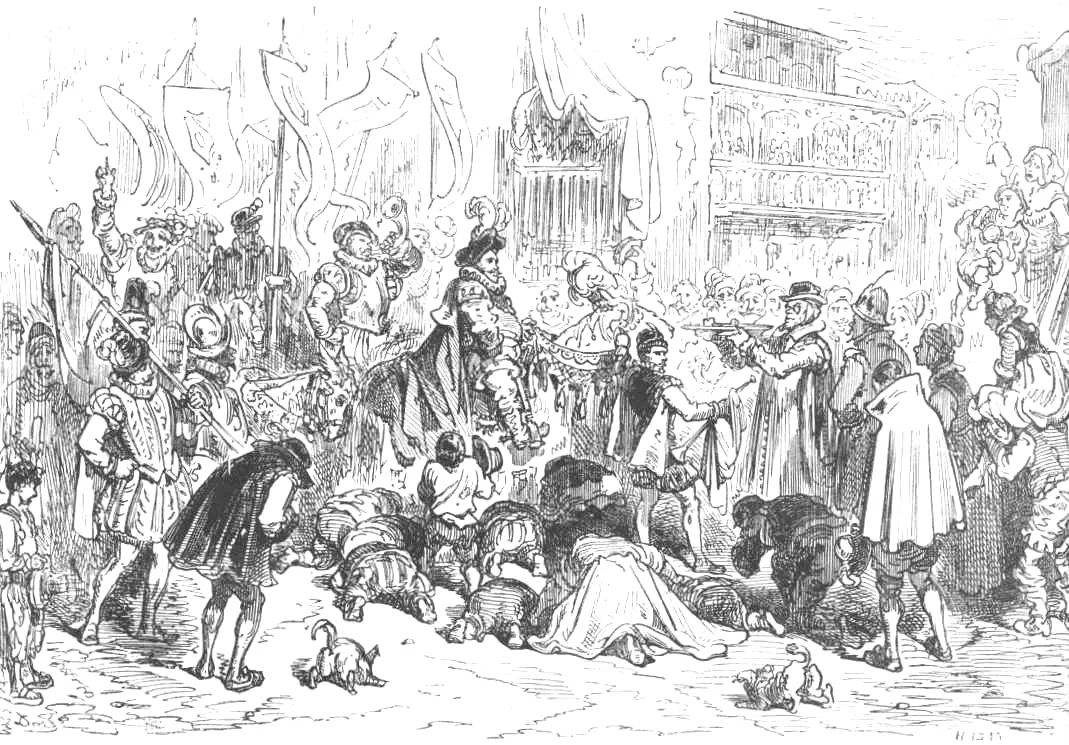
Sancho and his large escort arrived at a village of about a thousand households. It was one of the best the duke had. They told him it was called the island of Barataria. Whether because the village was named Baratario or because the governorship had come to him cheap, the narrator does not say for sure.
At the gates of the walled village, its leading men came out to meet him. Bells rang and everyone put on a show of joy. They took him to the great church to give thanks to God. Then, after some ridiculous ceremonies, they handed him the keys of the village and swore him in as governor of Barataria for life.
The new governor’s dress, his beard, his round, short body amazed everyone. Those who did not know the secret behind it all were amazed, and so were the many who did.
The name on the wall
When they came out of the church, they sat him in the judge’s seat. The duke’s steward spoke. “Lord governor, this island has an old custom. Whoever comes to govern it must answer a question that is rather tricky and hard. From the answer the people take the measure of the new governor’s wits, and they rejoice or grieve at his coming.”
While he was saying this, Sancho was looking at some large letters written on the wall opposite. He could not read, so he asked what those pictures on the wall were.
“Sir, written there is the day Your Lordship took possession of this island. It says, on such a day of such a month of such a year, this island passed into the hands of Don Sancho Panza, long may he enjoy it.”
“And who’s this Don Sancho Panza?”
“Your Lordship. No other Panza has entered this island but the one sitting in that chair.”
Sancho spoke. “Then take note, brother. I have no ‘don,’ and nobody in my family ever had one. I’m called plain Sancho Panza, my father was Sancho, my grandfather was Sancho. They were all Panzas, with no ‘dons’ or ‘doñas’ stuck on.”
He said this island seemed to have more dons than stones. If his government lasted four days, he would weed out those dons, which must be as annoying as mosquitoes. Then he told the steward to ask his question, and he would answer as best he could, whether the people rejoiced or grieved.
Five caps
Just then two men came into the courtroom. One was dressed as a farmer, and the other was a tailor holding a pair of scissors.
The tailor spoke. “Lord governor, yesterday this farmer came into my shop and held out a piece of cloth. He asked whether it would make a cap. I felt it and said it would.”
“Then, thinking I meant to steal some of his cloth, he asked if it would make two. I guessed what he was thinking and said yes again. So he kept adding caps and I kept saying yes, until we got to five.”
“But today he came to collect them, and though I’m handing over the caps, he won’t pay me for my work. Instead he wants me to give back the cloth or pay for it.”
“Is all this so, brother?”
“Yes, sir. But have him show you the five caps he made me.”
The tailor gladly agreed and drew his hand out from under his cloak. On each of his five fingertips sits a cap. “Here are the five caps this good man asked for. By God and my conscience, I kept none of the cloth. I’ll let the inspectors of my trade examine the work.”
Everyone in the room burst out laughing at all those caps and this new kind of lawsuit. Sancho thought for a moment and spoke. “I don’t think this case needs long delays, just a quick judgment by common sense. The tailor loses his fee and the farmer his cloth, and the jailed prisoners get the caps. And that’s the end of it.”
People laughed, but they did as the governor ordered.
The old man with the staff
Next came two old men. One leaned on a cane for a staff, and the one without a staff spoke first.
“Sir, out of kindness I once lent this man ten gold crowns. He was to pay them back when I asked. So as not to put him in worse straits, I went a long time without asking for them. But it seemed he had no intention of paying, so I asked him many times. Then, far from paying me, he says I never lent them, and if I did, he has already paid me back.”
He had no witness to the loan or to any repayment, he said, since there had been no repayment. So he asked the governor to put the man under oath. If he swore he had paid, the lender would forgive the debt in this world and before God.
“What do you say to this, old man with the staff?”
“Sir, I admit he lent them. Lower your rod. Since he rests it on my oath, I’ll swear I truly repaid him.”
Sancho lowered the judge’s rod. Then the old man with the staff, as if the cane were in his way, gave it to his opponent to hold during the oath.
He laid his hand on the cross at the top of the judge’s rod and swore. It was true he had borrowed the ten gold crowns, he said, but he had returned them from his hand to the other’s. The other must have forgotten and kept asking for them.
When Sancho asked the lender what he had to say, he said the man was good and devout, so it must be true. He must have forgotten how and when he was repaid, he said, and from now on he would ask for nothing. The debtor took back his staff, bowed his head and left the courtroom.
Split the staff
Sancho watched him walk off like that. He saw the patience of the lender, too. He bowed his head on his chest and, with his right index finger on his brow and nose, sat thinking a moment. Then he raised his head and had the old man with the staff, who had already gone, brought back.
When the old man was brought in, Sancho spoke. “Give me that staff, good man. I need it.”
“Gladly, sir. Here it is.”
Sancho took the staff and handed it to the lender. “Go with God. Now you’ve been paid.”
“Me, sir? Is this cane worth ten gold crowns?”
“It is. Or else I’m the biggest dunce in the world. Now we’ll see whether I’ve got the brains to govern a whole kingdom.”
He had the staff broken open in front of everyone. When the cane was split, ten gold crowns came out of it. Everyone was amazed and called their governor a new Solomon.
Fool or wise man
When they asked him how he knew the gold was inside the staff, Sancho said he had seen the old man hand the staff to the other only while he swore. As soon as he had sworn, he took it back. At that moment, Sancho said, it struck him that the money owed must be inside.
Those who govern, he said, even if they are fools, are sometimes guided by God in their judgments. Besides, he had heard a similar story from his village priest. He had a very good memory, he said. If only he did not forget everything he wanted to remember, there would be no memory like his on the whole island.
One old man left shamed and the other paid. The people present could not hide their amazement.
“…el que escribía las palabras, hechos y movimientos de Sancho no acababa de determinarse si le tendría y pondría por tonto o por discreto.” …the one keeping a record of all Sancho said and did, down to every gesture, could not decide whether to take him and write him down for a dunce or for a sage. (Part II, Chapter 45)
There were more cases that day. A record of the new governor’s rulings and judgments was sent straight to the duke, who was eagerly awaiting it.
The doctor who would not let him eat
From the courtroom Sancho was led to a splendid palace. In a great hall a clean and lavish table was laid, and as he came in pipes began to play. Four pages brought water for his hands, and Sancho received it with great dignity.
There was only one seat at the table. When Sancho sat in it, a man holding a thin rod of whalebone took his stand beside him. He turned out later to be a doctor.
A plate of fruit was set before him, and Sancho had barely taken a bite when the doctor tapped the plate with his rod. A page whisked it away like lightning. Another dish was set down, but before Sancho could taste it the rod touched it, and that plate vanished the same way.
Sancho was baffled and asked whether this meal was to be eaten like a conjuring trick.
The man with the rod spoke. “Lord governor, you must eat the way governors do on other islands. I am the doctor in charge of the health of this island’s governors, and I watch over your body day and night. I had the fruit removed because it was too moist, and that dish because it was too hot and spicy and causes thirst. Drinking a great deal kills the body’s vital moisture, where life resides.”
“Then those roast partridges over there, nicely seasoned, won’t do me any harm?”
“As long as I live, the lord governor shall not eat them. Hippocrates, the north star of medicine, said that all gorging is bad, but gorging on partridges is the worst.”
In that case, Sancho said, pick out whatever on this table was most good for him and least harmful, and let him eat it without beating it with the rod. He was dying of hunger, and keeping food from him would take his life rather than lengthen it. The doctor said the stewed rabbit would not do, nor the veal. When Sancho pointed at a great steaming pot of stew, the doctor cried “Begone!” in Latin. There was nothing in the world worse for the body than a stew, he said.
“What the lord governor should eat now is a hundred thin wafers and a few fine slices of quince paste. They will settle your stomach and help your digestion.”
The doctor of bad omen
Sancho leaned back in his chair and stared hard at the doctor. Then, in a grave voice, he asked his name and where he had studied. His name was Pedro Recio de Agüero, he said. He came from a village called Tirteafuera and held a doctorate from the university of Osuna.
Sancho flared up. “Then, Doctor Pedro Recio of Bad Agüero, from Tirteafuera, get out of my sight this minute! Or I’ll take a club and, starting with you, leave not one ignorant doctor on this island. Give me something to eat, or take back this post. A job that doesn’t feed its owner isn’t worth two beans.”
The original plays on the name of the doctor’s village. Tirteafuera can be read as “you, get out,” and Sancho really did try to throw him out. Frightened, the doctor made to leave the room.
The duke’s letter
Just then a courier’s horn sounded in the street. A sweating courier pulled a letter from his breast and gave it to the governor, and Sancho handed it to the steward. The address read: for Don Sancho Panza, governor of Barataria, to be placed in his own hands or his secretary’s.
“Who here is my secretary?”
One of those present said he could read and write and was a Biscayan, so he could be the secretary. Sancho said that with that extra qualification he could be secretary to the emperor himself, and told him to open the letter. Having read it, the secretary said it was a matter to be dealt with in private.
The duke’s letter said this. Enemies of the duke and of the island would launch a fierce attack one night, so the governor must keep watch. Four men in disguise had also come into the village to kill him, it said. He should watch who came to speak to him and eat nothing anyone presented.
Startled, Sancho spoke to the steward. “What we have to do right now is throw Doctor Recio in a cell. If anyone is going to kill me, it’s him, and by the worst death there is, starvation.”
The man who served the table added that the food on this table had been presented by some nuns, so the governor had better not eat it. There is a devil behind the cross, as they say. Then, said Sancho, give him a piece of bread and four pounds of grapes. No poison could get into those.
“If there’s a battle coming, I’d better eat well, for it’s the belly that carries the heart, not the heart the belly. Secretary, answer my lord the duke that his orders will be followed. Ask my lady the duchess to send my letter and bundle on to Teresa, and put in my respects to Don Quixote too. Let him see I’m bread that remembers who baked it.”
The farmer from Miguel Turra
Just then a page came in to say a farmer wished to see the governor on important business. Sancho grumbled that people always came with business at times like these. Those who govern are flesh and bone too, he said, and need their rest. Still, he had the man shown in, but told them first to make sure he was not an assassin.
The farmer who came in looked thoroughly good-natured. He knelt and said he was a farmer from Miguel Turra. One of his sons, he said, had fallen in love with Clara Perlerina, the daughter of a rich man in the same village.
He went on and on describing the girl. From the right she looked like a flower of the field, but not so much from the left, since smallpox had taken that eye. Her pockmarks were graves where her lovers’ souls lay buried, and though she was missing a dozen teeth, her mouth was big. She was bent so double that her knees touched her mouth, but if she could straighten up her head would touch the ceiling. Sancho listened, saying that if he had eaten, no dessert could beat this portrait.
His son was a fit match for her, the farmer said. He was tormented by evil spirits several times a day and had fallen into the fire once and had a wrinkled face, but he had the nature of an angel. Then he asked for a letter from the governor urging the other father to agree to the marriage, and six hundred ducats to set up the young couple’s house.
Sancho seized the chair he was sitting on. “You rude bumpkin, get out of my sight this instant or I’ll break your head with this chair! You come at this hour asking for six hundred ducats? Where would I have them, and if I did, why would I give them to you? I’ve held this post a day and a half, and already you want six hundred ducats out of me?”
At a wink from the man serving the table, the farmer bowed his head and went out, pretending to be afraid. The narrator writes that the sly fellow had played his part very well. That farmer, too, had been sent by the steward.
A seat set up for a laughingstock
In this chapter the seat Sancho took had been set up as a prank. The island lay not in the sea but on the duke’s land, and many of those who welcomed him knew the secret. The first day’s questions, the doctor at lunch and the farmer from Miguel Turra had all been prepared to make the new governor a laughingstock.
But the judgments that came from that seat were real. The governor who could not read called the letters on the wall pictures, yet he did not miss the staff passing back and forth in the hands of the man taking the oath. Even the man recording him could not decide whether he was a fool or wise.
Have you ever, where nobody expected anything of you, shown a skill even you did not know you had?