The barber slapped his knee at the curate’s plan. The two borrowed a skirt and a headdress from the innkeeper’s wife, leaving the curate’s new cassock with her in exchange. From the red ox tail on which the innkeeper hung his comb, the barber made a beard that came down to his waist.
When the innkeeper’s wife asked what they wanted these things for, the curate briefly told her of Don Quixote’s illness. At that, the innkeeper and his wife realized he was the guest who had drunk the balm, the master of the squire they had tossed in the blanket. They told everything, even the part Sancho had tried so hard to hide.
The innkeeper’s wife dressed the curate up convincingly. It was a woolen skirt with bands of black velvet and a bodice of green velvet, and the narrator writes that they looked as if they had been made in the days of King Wamba. Maritornes promised that, sinner though she was, she would say a rosary for their success.
A priest’s dignity
But no sooner had they left the inn than a thought came to the curate. However good the purpose, it was unseemly for a priest to go about dressed like this.
He asked the barber to swap clothes. If the barber played the damsel and he played the squire, a priest’s dignity would suffer less. If the barber refused, he would turn back here and now, whether the devil carried off Don Quixote or not.
Sancho, who had just caught up, burst out laughing when he saw what the two of them looked like. The barber agreed to do whatever the curate wished, and they decided to put on the costumes when they got near Don Quixote.
On the way Sancho told them about the madman they had met in the mountains. Only the bag and what was in it he left out. The narrator writes that for all his simplicity, he was a little greedy.
The story heard to the end
The next day they reached the broom branches Sancho had laid along the way. The two gave Sancho firm instructions. He was not to tell his master that he knew them. If asked whether he had delivered the letter, he was to say yes, and that Dulcinea wanted him in El Toboso at once.
While Sancho went to find his master, the two waited in the shade by a stream. Then they heard singing among the rocks, and when the song ended a young man in rags appeared.
It was Cardenio. This time his mind was clear, and he told them the rest of the story Don Quixote had broken off.
Fernando had sent Cardenio away on an errand and asked Luscinda’s father for her hand. Called back by an urgent letter, Cardenio slipped into the house on the day of the wedding and watched it all from behind a hanging.
When the priest who was marrying them asked, Luscinda hesitated a long while, then answered faintly. “Yes, I will.”
Hearing that, Cardenio fled the house and came up into these mountains. That Luscinda fainted at once and fell, and whatever happened after, he did not stay to see.
Feet in the stream
Just then a sad voice came from close by. When the three crept round behind a rock, they found a young man in farm clothes sitting under an ash tree with his feet in the stream.
There was something odd about those feet. They were far too white to be feet that trod the soil and followed a plough. When the young man took off his cap, golden hair tumbled down below the shoulders. It was not a boy but a young woman.
Startled by the noise, she tried to run, stubbed her foot on a stone and fell. The curate went up to her and calmed her gently. Whatever her trouble, he said, they would help as far as they could.
Her name was Dorotea. She was the only daughter of a rich Andalusian farmer, and the duke’s second son, Don Fernando, had pursued her and promised to marry her.
She believed that promise. Not long after, he left, and word came that he had married a young woman called Luscinda in another city.
She left home and went to that city, and there she heard what people were whispering. On the wedding night, when Luscinda fainted, a note in her own hand was found at her breast saying she was Cardenio’s wife, along with a dagger. And not long after, Luscinda vanished from her house.
Dressed as a boy to escape people’s eyes, she had hidden herself in these mountains.
When he had heard her, Cardenio told her that he was that very Cardenio. Luscinda might never have become Fernando’s after all. For the first time, the two of them see hope in each other’s stories.
Dorotea becomes a princess
Then Sancho came back calling for them. He had found his master, he said, in his shirt, thin, his face sallow, starving and calling on Dulcinea.
He had told him Dulcinea wanted him in El Toboso, but his master would not listen. Until he had done deeds that made him worthy of her favor, he would not appear before her.
The curate told Cardenio and Dorotea about their plan. Then Dorotea spoke up. As a damsel in distress, she said, she would do better than the barber, and she had the clothes for it too.
“I’ve read so many books of chivalry that I know exactly what words such damsels use when they ask a knight for a boon.”
From her bundle she took a skirt of fine cloth, a green mantle, a necklace and jewels, and in a moment she was dressed as a great lady. Everyone marveled, and said that Fernando, who had abandoned such beauty, had no eyes in his head.
The most amazed of all was Sancho. Never in his life had he seen anyone so beautiful, and he asked the curate who this lady was.
The curate kept a straight face and answered. “This lady is the rightful heir of the great kingdom of Micomicón. She has come all the way from Guinea, on the strength of his name alone, to beg your master to right a wrong done to her by a wicked giant.”
“That’s grand! As long as my master kills the giant and puts things right for her. But Father, so my master doesn’t take a fancy to being an archbishop, tell him to marry this princess right away. I’m married, so church work is no good for me.”
When Sancho asked the princess’s name, the curate said it was Micomicona. Her kingdom was Micomicón, so naturally that was what she was called.
Sancho nodded. People take the name of the place they were born, like Pedro of Alcalá or Juan of Úbeda. The queens of Guinea, he said, must do the same.
The princess on her knees
Dorotea got up on the curate’s mule and the barber put on his ox-tail beard. The curate and Cardenio stayed behind, for fear Don Quixote would remember his quarrel with Cardenio.
They had not gone far when they saw Don Quixote sitting among the rocks, dressed but not in his armor.
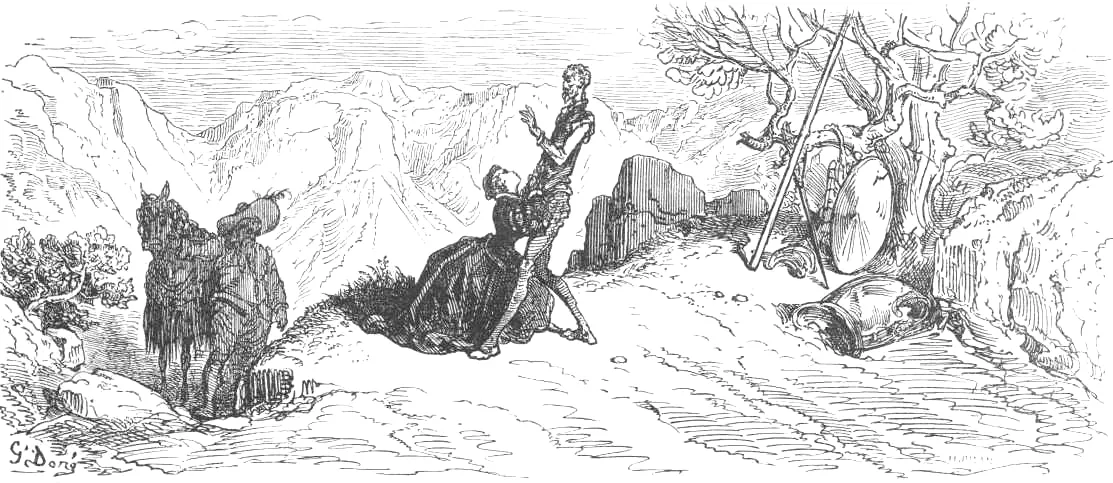
When Sancho pointed him out, Dorotea urged her mule forward and, the moment she dismounted, knelt before his knees.
Don Quixote tried to raise her, but she would not rise. “O valiant and mighty knight, I will not rise until thy kindness promises to grant me a boon. It is a boon that will bring glory to thy name and aid to the most wronged damsel the sun has ever seen.”
“Fair lady, I will not answer a word until thou risest.”
“I will not rise until thou grantest my boon.”
At last Don Quixote spoke. “I grant thee the boon. Provided only that it does no injury to my king or my country, nor to the lady who keeps the key of my heart and my liberty.”
Meanwhile Sancho whispered in his master’s ear. It was nothing much, only killing a giant, and the lady was the princess of the kingdom of Micomicón in Ethiopia.
The princess’s boon was this. To come with her now. And until he had taken vengeance on the traitor who stole her kingdom, to take part in no other adventure of any kind.
Don Quixote swore to do so, and without letting her kiss his hand he raised her courteously to her feet. Then he told Sancho to take down the armor hanging on a tree and arm him.
All this while the barber was still on his knees, struggling to hold back his laughter and keep his beard from falling off.
A squire on foot
With Don Quixote on Rocinante and the princess on the mule, Sancho had to follow on foot. The loss of his donkey came back to him all over again.
Still, he was happy. His master was sure to marry the princess and become king of Micomicón at the very least.
Meanwhile the curate shaved off Cardenio’s beard with scissors and put his own cloak on him, so that no one could have known him. The two took a shortcut and waited for the others on the high road.
When the party came out of the mountains, the curate looked at Don Quixote for a long time, then ran to him with open arms. “Mirror of chivalry, my own countryman Don Quixote of La Mancha, to meet you here!”
Only then did Don Quixote recognize the curate and try to get down from his horse. The curate would not hear of it, and in the end it was settled that the curate would ride the barber’s mule and the barber would sit up behind.
But the hired mule kicked out. As the barber tumbled off, the ox-tail beard fell to the ground too. He quickly covered his face with both hands and makes a great fuss that all his teeth had been knocked out.
Don Quixote cried out in amazement. “What a miracle! The whole beard has fallen off without a drop of blood!”
The curate swiftly picked up the beard and went to the fallen barber. Pressing the barber’s head to his chest, he muttered some charm and put the beard back on, and it stuck in place as if it had never moved.
Don Quixote marveled and begged him to teach him the charm. Since the spot where the beard fell off was unharmed, he said, the charm must surely heal more than beards.
The man who broke the chain
As they went along, the curate made up a reason for being there. On their way to Seville to collect some money, he said, they had met robbers near here who took everything, even their beards. And those robbers were galley convicts set free by a man who had struck down their guards.
“That man must have been out of his mind, or as great a villain as they are, or a man without soul or conscience. He set the wolf loose among the sheep and the fox among the hens.”
Sancho had already told him the story, so the curate was laying it on all the thicker. At every word Don Quixote’s face changed color, but he did not dare say that he was the man.
It was Sancho who spoke first. “Father, the one who did that was my master. And I warned him beforehand that they were all terrible villains and that setting them free was a sin.”
Don Quixote thundered at him. “You fool! It is no business of a knight errant to find out whether the chained and oppressed he meets on the road came to that by their own crimes. He sees them as people in need, and helps them looking not at their crimes but at their suffering.”
He rose in his stirrups. Apart from the curate’s holy office, he said, he would teach anyone who spoke ill of the deed with his sword. The helmet of Mambrino, that is to say the barber’s basin, hung from his saddlebow until he could mend the damage the convicts had done it.
The princess calms him. He had promised to take part in no other adventure until hers was done, so he should let his anger cool. The curate chimed in that if he had known that knight was this gentleman, he would have bitten his tongue three times over.
Princess Micomicona’s story
Instead of nursing his anger, Don Quixote made a request of the princess. Would she tell him what her trouble was, and on whom he was to take vengeance?
The princess settled herself in the saddle, coughed once and began. “First let me tell you all that I am called…”
There she stopped. She had forgotten the name the curate had given her.
The curate quickly broke in. Great misfortune makes people forget even their own names, he said, and slipped her the name Princess Micomicona.
Her story went like this. Her father was King Tinacrio the Wise, who was well versed in magic. He knew that after his death a giant from a neighboring island, Pandafilando of the Scowling Eye, would seize the kingdom.
This giant’s eyes are perfectly sound, yet he always looks crosswise at people to frighten them.
Her father told her to go to Spain. There, if she found a knight errant whose name had spread through the whole land, she could win back her kingdom. “The knight’s name, if I remember rightly, is Don Azote or Don Gigote…”
Sancho corrected her. “Don Quixote, you’ll mean. Also known as the Knight of the Sorry Face.”
The princess said her father had also told her what the knight looked like. Tall, lean in the face, and with a brown mole with hairs on it somewhere on his right side, under his left shoulder.
Don Quixote called to Sancho. “Sancho, help me get my clothes off. I must see whether I am the knight the wise king foretold.”
Sancho stopped him. He knew, he said, that his master had a mole like that right in the middle of his spine. The princess said that shoulder or spine, it was enough that there was a mole. It was all the same flesh.
When the princess said she had heard of him the moment she landed at Osuna, Don Quixote asked whether Osuna was not inland. The curate quickly explained that she meant Osuna was the first place she heard of him after landing at Málaga.
Last of all, the princess passed on one more prophecy of her father’s. If the knight, having cut off the giant’s head, wished to marry her, she was to become his wife without a word and give him her kingdom too.
The squire who said marry her
Don Quixote turned to Sancho. “Well, Sancho? What did I tell you? Have we not now a kingdom to rule and a queen to marry?”
Sancho kicked his heels twice in the air, then caught the reins of the princess’s mule, stopped it and knelt. He asked to kiss her hands as a sign that he took her for his queen. No one could keep from laughing, and the princess promised to make him a great lord once she had won back her kingdom.
But what Don Quixote added was quite different. Once he had cut off the giant’s head and set the princess on her throne, he said, she could do as she pleased. His heart was already held by another, and he had no thought of marrying, not even the phoenix.
Sancho flew into a temper. “You really aren’t in your right mind, master. Wavering over whether to marry a princess as high as this one! Is the lady Dulcinea any prettier than her? She can’t hold a candle to her shoe. Marry her right now, become king, and make me a marquis.”
Don Quixote could not bear it. Without a word he raised the shaft of his lance and struck Sancho twice, knocking him to the ground. If the princess had not cried out to him to stop, he would have beaten him more.
“Base wretch, how long dost thou think thou wilt go wrong and I forgive thee? If Dulcinea did not breathe strength into my arm, I would not have strength to kill a flea. It is she who does battle through me and wins through me, and in her I draw breath and have my being.”
Sancho hid behind the princess’s mule and talked back. If his master did not marry, there would be no kingdom, and then there would be nothing to give him. Why not marry the princess first and go back to Dulcinea afterward? “As for beauty, both of them look fine to me. Not that I’ve ever seen the lady Dulcinea.”
“Never seen her? You, who have just brought me her message?”
“I mean I never saw her long enough to look her over properly. At a rough glance she looked fine.”
Only then did Don Quixote forgive him, saying that a man’s first impulses are not in his own hands.
Sancho would not be outdone. “God’s in heaven seeing it all, so He’ll judge who’s worse. Me for speaking badly, or you for acting badly.”
At the princess’s word, Sancho bowed his head and kissed his master’s hand.
A made-up report
While the two went on a little ahead, behind them the curate praised Dorotea’s skill. Dorotea admitted that though she had read books of chivalry, she did not know where the ports were, so she had said Osuna at random.
The curate spoke. “Is it not strange? This poor gentleman believes such made-up stories so easily, only because they are told in the style of the books he has read. And yet, as long as no one touches on chivalry, no man talks more sensibly than he does.”
Ahead, Don Quixote was questioning Sancho. When and where had he met Dulcinea, what was she doing, what face did she make when she read his letter? He was to tell it all, adding nothing and leaving nothing out.
Sancho admitted that he had not taken the letter. Instead, he said, he had dictated it from memory to a sacristan, who said he had never seen so fine a letter. Sancho has never been anywhere near El Toboso.
“And that queen of all beauty, what was she about? Stringing pearls, surely, or embroidering in gold thread.”
“She was winnowing two sacks of wheat in her yard.”
“Then the grains of that wheat turned to pearls at the touch of her hands. Was it white wheat?”
“It was red wheat.”
“Winnowed by her hands, it will have made white bread. And when she received my letter, did she kiss it?”
“She was busy winnowing, so she told me to put it on that sack. She’d read it when she was done, she said.”
The questions went on. When asked whether he had smelled a fragrance near her, Sancho said that, maybe from the sweat, there was a bit of a mannish smell. Don Quixote said Sancho must have had a cold, or smelled himself. She was the rose among thorns, the lily of the field.
Sancho’s story went on. She could not read, so she tore the letter to shreds, for fear the villagers would learn her secrets. And she wanted his master to come out of the brush and come to El Toboso at once.
“What jewel did she give you at parting? It is an ancient custom to give a jewel to a squire who brings good news.”
“Maybe in the old days. Nowadays they seem to give a piece of bread and a piece of cheese. That’s what the lady handed me over the yard wall. Sheep’s cheese, it was.”
Don Quixote marveled that Sancho had gone more than thirty leagues and back in three days. Some enchanter on his side, he said, must have carried him through the air. Sancho agreed that Rocinante had run like a gypsy’s donkey with quicksilver in its ears.
Don Quixote wavers between wanting to go and see Dulcinea and the promise he had made the princess. And in the end, he decided to kill the giant first, set the princess on her throne and then go to Dulcinea.
The narrator writes that by then Sancho was tired of lying, and afraid his master would catch him out. He knew Dulcinea was a farm girl of El Toboso, but he had never once seen her in his life.
In chapter 13 he boasted that he knew her well, that she was the girl whose shout from the tower could be heard half a league off. The narrator does not make the two statements agree.
The boy at the spring
The party rested at a small spring and filled their stomachs with the food the curate had brought from the inn.
Just then a boy who was passing along the road looked closely at the people by the spring. Then he suddenly ran at Don Quixote, threw his arms around his legs and began to cry. “Oh, master! Don’t you know me? Look at me well. I’m Andrés, the one you untied from the oak.”
Don Quixote recognized him. He took the boy by the hand and turned to the others. “See, all of you, why there must be knights errant in the world. Some days ago, I heard pitiful cries in a wood and rode to them, and found this boy tied to an oak and being whipped. I had him untied, and made his master swear to pay him his wages to the last coin.”
He turned to the boy for confirmation. “Is it not so, Andrés? Did you not see how meekly the man swore? Tell these people what happened.”
An ending turned upside down
The boy answered. “Everything you say is true, master. But the end of it went the exact opposite of what you think.”
“The opposite? Did the fellow not pay you?”
“Not paying me was the least of it. As soon as you’d gone from the wood and it was just the two of us, my master tied me to that oak again. Then he beat me until I looked like Saint Bartholomew flayed. With every lash he made a joke mocking you, and if it hadn’t hurt so much I’d have laughed too.”
Ever since, Andrés said, he had been in the hospital getting better. Then he went on. “It’s all your fault. If only you hadn’t come where nobody called you and meddled in other people’s business. My master would have given me a dozen or two lashes, let me go and paid me everything. Because you went and shamed him and heaped insults on him, he poured onto me all the rage he couldn’t pay back to you.”
Don Quixote spoke. “The mistake was in my leaving. I should not have gone until I saw you paid. I ought to have known from long experience that no farmer keeps his word when it does him no good. Still, Andrés, you will recall my oath that, should he fail to pay, I would hunt him down though he hid inside a whale.”
“I remember. But it didn’t do any good, did it?”
“Now you shall see whether it does.”
The earlier promise
Don Quixote sprang to his feet and told Sancho to bridle Rocinante, who was grazing.
The princess asked what he meant to do. He said he would go after that farmer, punish him and make sure Andrés was paid to the last coin.
The princess reminds him. He had promised to take part in nothing else until her business was done. So he should hold back his anger until he returned from her kingdom.
Don Quixote said she was right. “As thou sayest, lady, Andrés must be patient until I return. But I swear once more that I will not rest until he is repaid.”
Andrés does not believe that oath. “I don’t believe oaths like that. Give me all the vengeance in the world, and I’d still rather have enough to get me to Seville. If you’ve got anything to eat, give me some. And farewell to you and all the knights errant in the world. I hope they do as well by themselves as they’ve done by me.”
A piece of bread and a piece of cheese
Sancho takes a piece of bread and a piece of cheese from the food sack and hands them to the boy. “Here, brother Andrés. A share of your bad luck has fallen to all of us.”
“And what share has fallen to you?”
“This share of bread and cheese I’m giving you. Only God knows whether I’ll miss it myself. A knight errant’s squire is always hungry and always unlucky.”
Andrés took the bread and cheese. And seeing that no one was going to give him anything else, he bowed his head and set off.
But as he left, he had one more thing to say to Don Quixote. “For God’s sake, sir knight errant. If you ever come across me again.”
“…aunque vea que me hacen pedazos, no me socorra ni ayude, sino déjeme con mi desgracia…” …even if you see them tearing me to pieces, don’t rescue me or lend a hand, just leave me in my misfortune… (Part I, Chapter 31)
“It can’t be worse than the misfortune that comes of your help. May God curse you and every knight errant ever born.”
When Don Quixote rose to punish him, Andrés ran off so fast that no one could have caught him.
Don Quixote was deeply ashamed. The others struggled to hold back their laughter, so as not to crush him altogether.
What remains after leaving
What Don Quixote saw in chapter 3 was a knight who stopped a whipping. That day he told Dulcinea that he had righted the greatest wrong cruelty had ever committed.
What Andrés saw was what came after. Once the knight was out of the wood the lashes doubled, and each came with a joke mocking the knight. He spent the end of it in a hospital.
Don Quixote said the mistake lay in leaving. Yet at that very moment he was unable to stay again. An earlier promise held him back, and the princess who had drawn that promise from him was a woman playing a part to take him home.
What was left in Andrés’s hands that day was a piece of bread and a piece of cheese from Sancho.
What he had wanted from the start was not vengeance but enough to reach Seville. The cost of the help was set not on the day the hand reached out but on the day after, and who ought to pay it, the original does not decide.
Have you ever helped someone and then found out, to the end, how they fared afterward?